



IELTS English course Singapore, key differences from general English for test takers
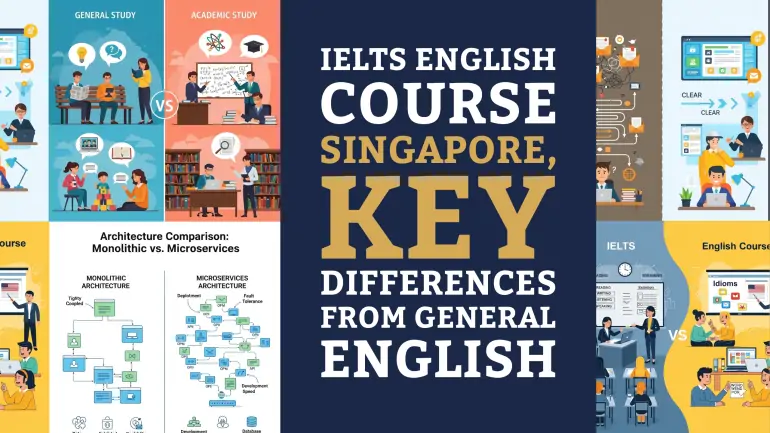
Table of Contents

TL;DR: IELTS vs general English
- An IELTS English course Singapore is exam focused, a general English class builds broad language skills.
- IELTS classes train timing, task types, and marking criteria, general English prioritises fluency and everyday communication.
- Expect mock tests, band-based feedback, and a study plan that targets your gap to the required band.
- Choose IELTS if you have a deadline or need Academic or General Training scores for study or migration.
- Keep general English for foundations, then switch to IELTS when you are within one band of your goal.
If you live or study in Singapore, you will find many English classes and several exam options. The phrase IELTS English course Singapore appears across brochures and ads, yet not every course is designed for the exam. Mixing general English with exam prep can slow progress, waste fees, and create confusion about what to practise each week. A clear distinction helps you choose the right format for your goal and deadline.
Who should choose an IELTS English course in Singapore
You need a dedicated IELTS preparation course Singapore if you have a university application, professional registration, or migration timeline. It also suits learners who perform well in Listening and Reading but cannot lift Writing or Speaking without targeted marking.
Who benefits from general English first
A general English course helps if grammar basics are shaky or you struggle to communicate on everyday topics. Build confidence for a few months, then move into an exam-focused timetable once your placement tests suggest you are within one band of your target.
What an IELTS English course Singapore includes that general English does not
An exam course is built around the test format, timing, and band descriptors. You learn methods that can be rehearsed, repeated, and graded against official criteria.
Syllabus features unique to an IELTS English course
Task types by paper, for example Matching Headings, True False Not Given, and Map Labelling in Reading, plus Task 1 visuals and Task 2 essay families in Writing.
Timing drills, strict windows that reflect test pressure, not open-ended discussions.
Band-based feedback, comments mapped to Task Response, Coherence and Cohesion, Lexical Resource, and Grammatical Range and Accuracy.
Mock tests, full or sectional, with score tracking and action points.
What general English covers instead
General courses emphasise conversation range, functional language, and grammar coverage such as tenses, conditionals, and modals. Reading and listening focus on everyday topics with less pressure on time. Writing tasks include emails, opinions, and reports with flexible length and style.
IELTS English course Singapore vs general English, outcomes and measurement
You cannot improve what you do not measure. Exam preparation uses evidence to guide study, while general English measures progress by participation. Compare outcomes using a structured IELTS study plan to track Reading speed, Listening accuracy, Writing Task 2 structure, and Speaking long turns.
Outcomes measured in an IELTS English course
Faster paragraph mapping and answer location under time in Reading.
Fewer distractor errors in Listening Section 3 and 4.
Task 2 essays that fully answer the question and show logical paragraphing.
Speaking Part 2 long turns that reach the time limit with a clear close.
Two recent mock tests at or above the required band.
Outcomes in general English
More confident conversations on a wider range of topics.
Broader vocabulary and better control of common grammar.
Improved comprehension of longer texts without exam timing.
Teaching approach, how classes are run
A good IELTS English course in Singapore follows a cycle of teach, practise, test, and review. Each week focuses on a specific method, applied in controlled drills, tested under timed conditions, and reviewed with band-based feedback.
Listening and Reading inside an IELTS English course Singapore
You will practise predicting answer forms from stems, tracking signposting language, and recovering after you miss a line. Reading work starts with skimming for gist, scanning for detail, and paragraph mapping. You train logic checks for high-risk items such as True False Not Given so you avoid guesswork.
Writing and Speaking that target the descriptors
Writing practice centres on task fulfilment and coherence. You will plan in five minutes, write within time, and self-check against the band descriptors before submitting. Speaking drills use recorded attempts, a one-minute planning method for Part 2, and structured development for Part 3 with linking phrases you can control.
Schedules that fit real life, picking the right format
Singapore learners often juggle work, school, and family. The right timetable is the one you will keep.
Typical schedules for an IELTS English course Singapore
Standard: two or three sessions per week for 8 to 12 weeks, with homework and a mock every second week.
Intensive: four or five shorter sessions per week if your test date is close.
Weekend: longer blocks on Saturday or Sunday, suitable for busy professionals.
When a general English timetable is better
Choose general English if you need months of steady exposure to build grammar and vocabulary. Once you are stable at that level, move to an exam timetable to convert language ability into band scores.
Cost and value, how to decide without guesswork
Fees vary across providers. Value comes from measurable progress and structured feedback, not the number of hours alone. Ask to see sample marked essays with comments tied to band descriptors. Confirm whether mock tests are included and how often they occur. Request a sample timetable that shows where timing practice sits each week.
Red flags to watch for
No mock schedule or vague promises about tests.
Feedback that is only a band number without comments or action points.
Overuse of rare vocabulary lists with little focus on task response and coherence.
Classes that are mostly free conversation with little timed work.
Practical study plan to pair with class time
Class hours are your anchor, but improvement grows from what you repeat between sessions. Use this simple weekly plan for eight to twelve weeks.
A repeatable week for exam gains
Listening: one section a day, note distractors, write two new collocations.
Reading: one passage every other day, paragraph mapping, then scan for five facts.
Writing: one Task 2 essay and one Task 1 response per week, both timed.
Speaking: two recorded long turns, review and note two fixes for the next attempt.
Review: update an error log. Record the incorrect item, the corrected form, the rule, and a new model sentence.
When to switch from general English to an IELTS English course
Make the switch when placement or recent mocks suggest you are within one band of your target, for example 6.0 aiming for 7.0. If you are more than one band away, split your time: two months of general English, then move to targeted exam prep.
Booking the real test with evidence
Book the test only after two consecutive mocks meet or exceed your target and your Writing or Speaking is not more than half a band behind your receptive skills. This rule protects your fees and morale.
What the official criteria say, aligning your practice
Understanding how the test is marked keeps your study honest. The official explanation of Academic and General Training formats clarifies task types and what examiners expect across the four skills. For details that you can trust, see the IELTS test format explained on the official site:
A subtle next step
If you want a timetable that fits your week, with mock tests and band-based feedback, explore an IELTS English course in Singapore that aligns with your deadline and target band: https://unitedceres.edu.sg/academic-courses/preparatory-course-for-international-english-language-testing-system-ielts/
FAQ
Is an IELTS English course in Singapore better than general English for fast results.
If you have a deadline or need a specific band, yes. Exam classes target timing, task types, and marking criteria, which move the score faster than broad fluency work.
Can I start with an IELTS course if my grammar is weak.
It is possible, but progress is usually slow. Build grammar foundations in general English for a few months, then switch to exam prep to convert skills into band scores.
How often should I sit mock tests in an IELTS English course Singapore.
Every two to three weeks works for most learners. Use the results to adjust study time and only book the real test after two qualifying mocks.
Which is harder, Academic or General Training.
They test different outcomes. Academic Writing Task 1 uses visuals, while General Training uses letters. Choose based on your goal and confirm with your institution.
What if my Writing score is always lower than Listening and Reading.
Increase essay frequency, plan for five minutes, and get line-level feedback. Many gains come from task response and coherence rather than rare vocabulary.
Do general English classes still help if I plan to take IELTS later.
Yes. General classes raise your overall language level. When you are within one band of your target, move into exam prep for timing and task control.