



Top IELTS Writing Task 2 Tips: Improve Your Score with Expert Strategies
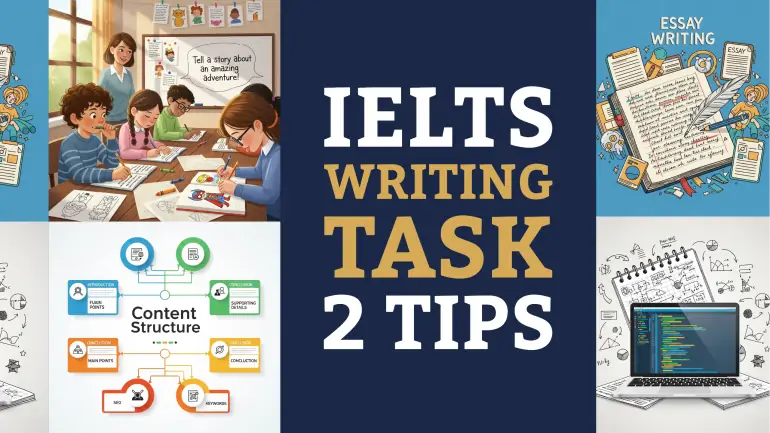
Table of Contents


TL;DR: IELTS Writing Task 2 Tips
If you’re aiming for a strong IELTS Writing Task 2 score in the 2026 exam, focus on mastering essay structure, idea development, and coherence rather than memorizing templates. Understand the question type, plan before you write, and practice expressing balanced arguments with clear examples.
IELTS Writing Task 2 Tips
Preparing for the IELTS Writing Task 2 can feel like standing at the base of a mountain; you know you have to climb it, but the path isn’t always clear. Many students worry about how to organize their thoughts, what kind of vocabulary to use, or how to make their essays sound academic enough. But the truth is, you don’t need complicated words or fancy sentences to score well. What you really need is clarity, structure, and practice. Some students find that enrolling in a structured IELTS course in Singapore helps expand vocabulary through guided exercises and peer feedback. In this guide, we’ll break down practical IELTS Writing Task 2 tips that’ll help you approach the 2026 IELTS exam with confidence and strategy without losing your natural writing voice.
Understanding IELTS Writing Task 2
The IELTS Writing Task 2 section often intimidates candidates more than Task 1. Why? Because it doesn’t just test your grammar or vocabulary, it examines how well you think, structure your ideas, and communicate under time pressure.
You’re expected to write a 250-word essay in about 40 minutes. The topic could range from social issues and education to technology, environment, or public health. The question always asks for your opinion, discussion, solution, or argument. In essence, it’s about writing like a clear thinker, not just a fluent English speaker.
1. Learn the Common Question Types
You can’t prepare for every topic, but you can prepare for the types of questions. The IELTS Writing Task 2 usually falls into one of these categories:
- Opinion essays (e.g., Do you agree or disagree?)
- Discussion essays (e.g., Discuss both views and give your opinion)
- Problem-solution essays
- Advantages and Disadvantages Essays
- Direct question essays (e.g., What are the causes of this? Do you think it’s positive or negative?
Once you identify the type, your approach becomes easier. For instance, a discussion essay needs two sides and a balanced conclusion, while an opinion essay needs a strong stance backed by reasons.
A good exercise? Take any past paper and label it Ah, this one’s a problem-solution question. The more you practice identifying these, the faster your brain recognizes them during the actual test.
2. Plan Before You Write
It’s tempting to jump straight into writing because, well, forty minutes feels short. But trust me skipping the planning stage is like trying to build a house without a foundation.
Spend the first five minutes analyzing the question and brainstorming ideas. Use quick notes:
- What’s the main topic?
- What’s your stance?
- What are two strong reasons or examples you can give?
Once you’ve got a structure in mind, the essay practically writes itself.
This is one area where a guided IELTS training programme can make a real difference. For instance, at United Ceres College an IELTS preparation classes, instructors help students break down topics logically before writing. That habit saves time and boosts coherence.
3. Master the Essay Structure
Even if your vocabulary is limited, a clear structure can still get you a good score. Most high-scoring IELTS essays follow this reliable format:
Introduction:
- Paraphrase the question.
- State your position or what you will discuss.
Body Paragraph 1:
- Present your first main idea.
- Support it with a reason or example.
Body Paragraph 2:
- Introduce your second main idea.
- Provide support or contrast.
Conclusion:
- Summarize the main points.
- Reaffirm your opinion (no new ideas here).
Simple, right? Yet many students lose marks because they wander off-topic or cram too many points into one paragraph. Stick to two main ideas, each fully developed. That shows clarity and organization, exactly what examiners reward.
4. Write Clearly, Not Complicatedly
One of the biggest misconceptions about IELTS Writing Task 2 is that you need to sound academic. Students try to use fancy words like ameliorate, aforementioned, or therein, thinking it’ll impress the examiner.
But in reality, it can make your writing sound unnatural. The examiners are not looking for Shakespeare; they’re looking for clarity and control.
Instead of saying:
The aforementioned predicament has ameliorated through technological intervention.
Say:
Technology has helped solve this problem.
See the difference? It’s clean, confident, and clear.
Remember: Good writing is about communication, not decoration.
5. Use Examples That Feel Real
When you’re writing under pressure, examples can be your best friend; they make your argument relatable and credible. The trick is to keep them realistic, not necessarily factual.
For instance:
Many young people now prefer online courses because they can balance work and study at the same time.
That’s a believable statement. You don’t need real statistics. Just make sure your examples sound plausible.
If you’ve attended an IELTS Writing workshop or mock test at a training center, you’ve probably noticed how teachers encourage you to develop examples from daily life. This technique grounds your essay in reality, making it easier to follow.
6. Don’t Forget Cohesion and Coherence
Two words you’ll hear a lot when preparing for IELTS Writing Task 2 are cohesion and coherence.
Cohesion means how your ideas connect using linking words like however, therefore, in addition, and for example.
Coherence means how logically your ideas flow.
For instance:
Many people argue that governments should invest in public transport. However, others believe that improving roads is more effective. Personally, I think both are necessary to reduce traffic problems.
See how smooth that reads? The connectors guide the reader effortlessly through your argument.
Try not to overuse linkers, though. Some students throw in ten moreovers and furthermores that just clutter the essay. Natural connection matters more than flashy transition words.
7. Manage Your Time Like a Pro
You have 60 minutes for the entire writing test 20 for Task 1, 40 for Task 2. But since Task 2 carries more weight (about two-thirds of your writing score), give it the attention it deserves.
Here’s a realistic time split:
- 5 minutes for planning
- 30 minutes for writing
- 5 minutes for proofreading
When you practice, try using a timer. This habit trains your brain to think and write efficiently within that 40-minute limit.
And don’t skip the last five minutes; it’s your chance to catch those sneaky grammar mistakes or missing articles. A missing the or an might not seem like a big deal, but in IELTS, those small slips add up.

8. Develop Vocabulary Gradually
There’s no magic word list that’ll get you a Band 8 overnight. The goal is not to memorize rare words but to use the right words naturally.
For instance, if you’re talking about environmental issues, words like pollution, sustainability, and renewable energy are useful. If the topic is education, focus on curriculum, assessment, or literacy.
Make your vocabulary topic-specific rather than random. And practice writing sentences with those words, not just reading them.
It’s less about memorization and more about application, which makes a big difference on test day.
9. Learn From Model Essays, But Don’t Copy
Model essays are excellent learning tools. They show how high-scoring candidates organize their ideas and use cohesive language.
But copying them word-for-word is risky not just because it’s unethical, but because it might not fit your natural writing style.
Instead, analyze why the essay works:
- How is the introduction phrased?
- How does the writer transition between points?
- What kind of examples or phrases make it flow?
Then try to replicate the technique, not the content. Over time, you’ll develop your own confident style.
10. Practice Writing Under Exam Conditions
Writing for practice and writing under time pressure are two different skills. You may produce great essays when relaxed, but can you do the same in 40 minutes with no spell-check, no Google, and no distractions?
That’s where mock tests come in. Simulate the test environment: same time limit, no extra notes, same paper type.
If you join an IELTS preparatory class, you’ll likely get these mock sessions as part of your routine. Teachers evaluate your essay based on actual IELTS criteria, pointing out your weak spots before it’s too late to fix them.
11. Pay Attention to Grammar and Sentence Variety
A common reason for losing marks is the repetition of sentence structure. Try to mix it up:
- Simple sentence: Many people work from home today.
- Many people work from home today, which helps them save time on commuting.
- Complex sentence: Since many people work from home today, they can spend more time with their families.
You don’t need to be a grammar wizard, but you should show that you can handle different structures accurately.
Practicing this with feedback, for example, from teachers at United Ceres IELTS training helps you pinpoint repetitive patterns and improve naturally.
12. Review, Reflect, and Revise
Improving your writing isn’t about doing ten essays a day. It’s about writing one essay thoughtfully, reviewing your mistakes, and trying again.
Look at your old essays. Do you tend to repeat ideas? Forget connectors? Go off-topic? Recognizing your weak areas is the first step to fixing them.
Some students even keep a mistake diary, noting common grammar or vocabulary errors. After a few weeks, patterns become obvious, and improvement feels more tangible.
13. Keep a Calm Mind During the Test
Sounds simple, but it’s underrated. Many candidates panic halfway through and lose track of their argument.
Before the test starts, take a deep breath and remind yourself: you’ve practiced for this. Once you begin writing, focus on one paragraph at a time instead of the whole essay.
Even if you make a small mistake, don’t cross out entire sentences; just correct them neatly and move on. The goal is a readable, logical essay, not perfection.
14. Don’t Depend on Memorized Templates
You might have come across essay templates online: Use this format to get Band 8! While they can help you learn structure, relying on them too much can make your writing sound robotic.
Examiners can easily spot memorized phrases like It is a universally acknowledged truth that… or Nowadays, it is often argued that…
Use your own voice. It’s okay if your sentences are simple, as long as they’re yours. That authenticity often makes your writing stand out.
15. Stay Updated and Keep Practicing for 2026
The IELTS topics evolve with current global trends, from AI in education to climate change or work-life balance. Keep yourself informed by reading English articles, essays, and news. It helps you generate ideas during the test.
If you’re aiming to take the 2026 IELTS exam, now is the perfect time to build consistency. Writing one essay a week, getting feedback, and tracking progress can transform your skills by exam season.
And if you prefer structured guidance, consider enrolling in a reputable IELTS preparatory course in Singapore, where professional instructors can coach you on strategy, vocabulary, and time management.
Final Thoughts
IELTS Writing Task 2 is less about English brilliance and more about clarity, logic, and confidence. You don’t need to sound like a scholar; you need to sound like yourself, but organized and thoughtful. Approach each question calmly, plan your ideas, and write as if you’re having a meaningful conversation with the reader. Consistent preparation, whether through self-study or a structured IELTS preparatory course in Singapore can help you build the clarity and confidence needed for a higher band score. Remember: every essay you write, even the messy ones, is a step forward. By the time 2026 rolls around, you’ll not only be ready for the test but also proud of how far you’ve come.