



What Does an MLOps Engineer Actually Do?
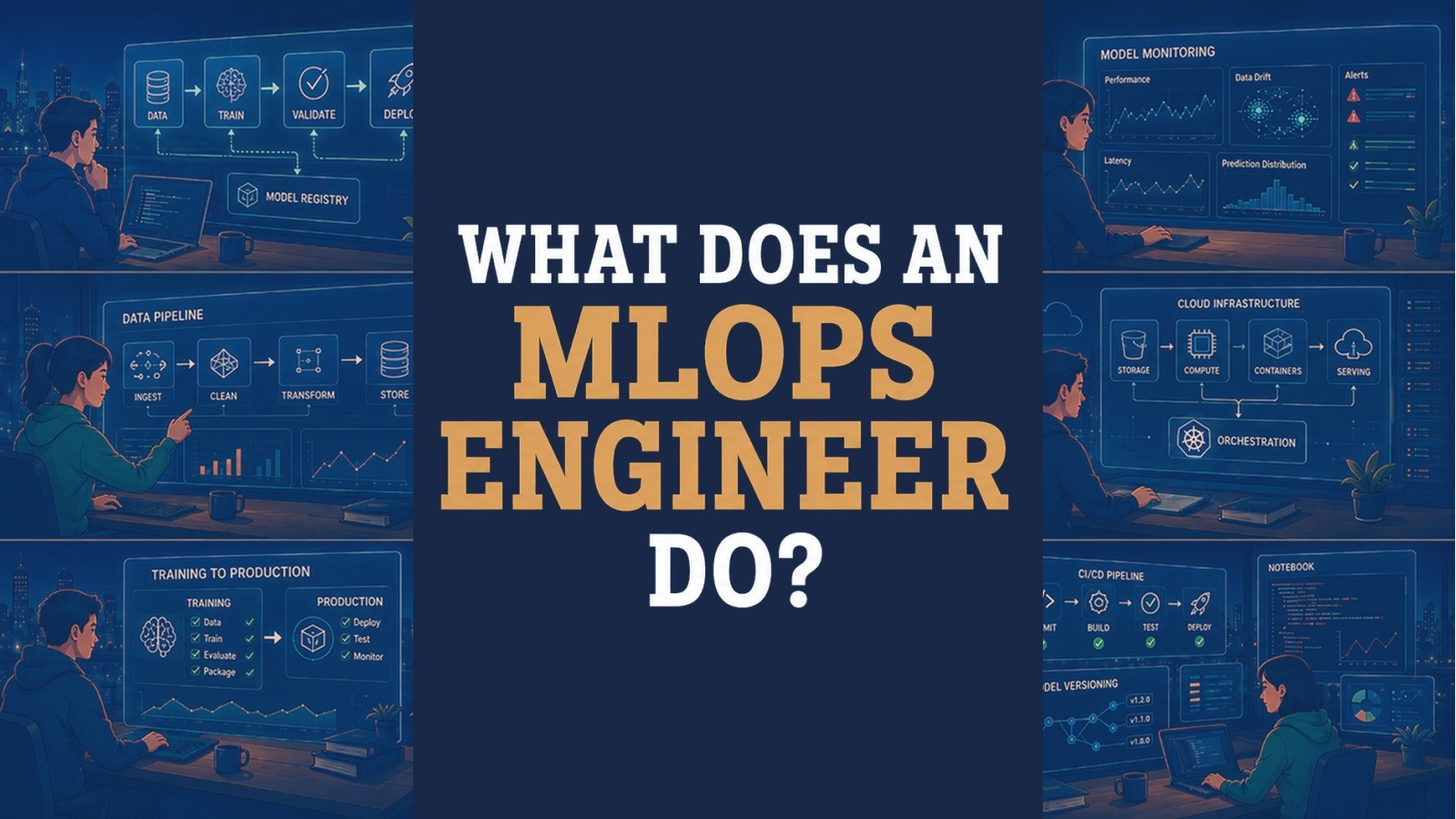
Table of Contents


TL;DR: What Does an MLOps Engineer Actually Do?
- MLOps Engineers build, deploy, monitor, and maintain machine learning systems, helping AI models work reliably in real-world environments.
- While data scientists often focus on data analysis, experimentation, and model development, MLOps Engineers typically focus more on the infrastructure, automation, deployment, and monitoring needed to operate machine learning systems in production.
- MLOps combines machine learning, software engineering, automation, and cloud technologies to support the effective use of AI applications in organizations.
- Students interested in AI careers can build relevant foundations through programming, machine learning, and practical technology skills. At United Ceres College, Machine Learning Operations is included as a module in the Advanced Diploma in Applied Artificial Intelligence, giving students an opportunity to explore this area as part of their broader AI studies.
Many students interested in artificial intelligence (AI) hear about roles like data scientist, machine learning engineer, or AI developer. However, one role that is becoming increasingly important in modern AI development is the MLOps Engineer. An MLOps Engineer helps organizations move machine learning models from the development stage into real-world use. Students interested in MLOps can begin by building foundations in programming and machine learning before progressing to deployment, automation and monitoring concepts. At United Ceres College, Machine Learning Operations is one of the six modules in the Advanced Diploma in Applied Artificial Intelligence program, alongside areas such as computer vision, conversational AI, deep learning, NLP and generative AI systems.
Creating an AI model is only one part of building a successful AI solution. A model may perform well during testing, but businesses need systems that continue working when thousands or millions of users interact with them. This is where MLOps becomes important. For example, a company may develop an AI system that recommends products to customers. A data scientist may create the recommendation model, but an MLOps Engineer helps ensure that the model is properly deployed, receives updated data, maintains performance, and can handle increasing numbers of users. In simple terms: A data scientist creates and improves the model. An MLOps Engineer helps the model work reliably in the real world.
What Is MLOps?
MLOps stands for Machine Learning Operations. It combines practices from the following:
- Machine learning
- Software engineering
- Data engineering
- DevOps (development and operations)
- Cloud computing
The goal of MLOps is to create a smooth process for developing, deploying, and maintaining machine learning systems. Traditional software applications usually follow a development process where developers write code, test it, deploy it, and update it when needed. Machine learning systems are more complex because they depend on the following:
- Data quality
- Model performance
- Changing user behaviour
- Continuous updates
An AI model that works well today may become less accurate in the future if the data changes. For example, a fraud detection system used by a bank may need regular updates because customer behaviors and fraud techniques continue to change. MLOps provides the tools and processes needed to manage these changes.
Why Is MLOps Important?
Many people think building an AI model is the final step in creating an AI solution. In reality, deployment and maintenance are often some of the most challenging parts. A machine learning model must work outside a testing environment. Businesses need to answer questions such as:
- How can the model be made available to users?
- How can performance be monitored?
- What happens if accuracy decreases?
- How can new versions be released safely?
- How can large amounts of data be managed?
Without proper operations, even a highly accurate AI model may fail when introduced into real-world situations. For example: A healthcare organization may develop an AI tool that helps analyze medical images. Before doctors can use it, the organization needs systems to ensure the following:
- The model is securely deployed
- Data is processed correctly
- Model performance is monitored against appropriate validation criteria
- Updates can be introduced safely
MLOps professionals may support these processes alongside data science, software, security, clinical, and governance teams.
MLOps Engineer vs Data Scientist vs Machine Learning Engineer
Many AI-related roles overlap, which can make career choices confusing. Understanding the differences can help students decide which area matches their interests.
| Role | Main Focus | Common Responsibilities |
| Data Scientist | Finding insights and creating models | Data analysis, experiments, model development |
| Machine Learning Engineer | Building machine learning applications | Developing algorithms, integrating models into software |
| MLOps Engineer | Managing AI systems in production | Deployment, automation, monitoring, infrastructure |
While these roles often work together, their responsibilities often differ, although the boundaries vary between organizations. A simple example: Imagine an online shopping platform wants to predict what products customers may like.
Data Scientist:
- Studies customer behaviour
- Creates recommendation models
- Tests different approaches
Machine Learning Engineer:
- Builds the software that uses the model
- Connects the AI system with the application
MLOps Engineer:
- Deploys the model
- Monitors performance
- Automates updates
- Ensures the system works reliably
What Are the Main Responsibilities of an MLOps Engineer?
The daily work of an MLOps Engineer can vary depending on the organization, but several responsibilities are common across industries.
1. Deploying Machine Learning Models
One common responsibilities of an MLOps Engineer is moving machine learning models from development environments into production systems. A model created by a data scientist may work well on a computer during testing. However, businesses need it to operate within real applications. Deployment involves:
- Preparing the model for use
- Connecting it with existing systems
- Managing technical requirements
- Supporting reliable operation and performance
For example:
A company creates an AI chatbot for customer support. The MLOps Engineer helps make the chatbot available on the company website and ensures it can handle customer requests efficiently.
2. Automating Machine Learning Workflows
MLOps Engineers use automation to reduce manual work and improve reliability. Machine learning projects often involve repeated tasks, such as:
- Collecting data
- Training models
- Testing updates
- Deploying new versions
Instead of completing these tasks manually each time, MLOps Engineers create automated workflows. Automation can help teams:
- reduce repetitive manual work;
- reduce some types of human error;
- standardise workflows; and
- deploy tested updates more efficiently.
For example: A financial company may update its fraud detection model every month. Automation allows the team to test and deploy new versions more efficiently.
3. Monitoring AI Model Performance
Machine learning model performance can degrade when the data encountered in production differs from the data used during development. This may involve data drift, concept drift or changes in the environment in which the model operates. This happens because real-world data changes. For example: A language translation model trained on older language patterns may become less effective as new terms and expressions appear. MLOps engineers monitor the following:
- Model accuracy
- System performance
- Data quality
- User interactions
If problems appear, they work with other AI professionals to improve the system.
4. Managing Data Pipelines
Machine learning models depend heavily on data. Poor-quality data can lead to inaccurate results. MLOps Engineers may help build, maintain or integrate the data and feature pipelines that support machine learning workflows, often working alongside data engineers. This includes:
- Collecting data
- Cleaning data
- Processing information
- Preparing data for models
For example:
An online retailer may collect customer search behaviour, purchase history, and product information. These data sources must be organised properly before an AI recommendation system can use them.
What Skills Does an MLOps Engineer Need?
MLOps sits at the intersection of machine learning, software engineering, and IT operations. Because of this, MLOps Engineers often develop a mix of technical and problem-solving skills rather than focusing on just one area. The exact skills required vary by role and employer, but the following areas are commonly valued.
Programming Skills
Programming is an important part of MLOps because engineers automate workflows, build deployment pipelines, and manage machine learning systems. Common programming languages include:
- Python
- Bash
- SQL
- Java (in some organisations)
- Go (for certain cloud-native applications)
For example, an MLOps Engineer might write a Python script that automatically retrains a machine learning model whenever new data becomes available. The goal is not simply to write code but to create reliable, repeatable processes that reduce manual work.
Understanding Machine Learning
Although MLOps Engineers may not spend most of their time designing AI models, understanding how machine learning works is essential. Useful topics include:
- Supervised learning
- Unsupervised learning
- Model training
- Model evaluation
- Feature engineering
- Model accuracy
- Overfitting and underfitting
For instance, if a deployed model suddenly becomes less accurate, an MLOps Engineer should understand possible causes and work with data scientists to investigate the issue.
Cloud Computing
Many AI systems run on cloud platforms rather than local computers. As a result, MLOps Engineers often work with cloud services that provide computing power, storage, and deployment tools. Examples include:
- Amazon Web Services (AWS)
- Microsoft Azure
- Google Cloud Platform (GCP)
Imagine a streaming service that serves millions of users daily. Hosting AI systems on cloud platforms allows the service to scale resources based on demand instead of relying on a single physical server.
DevOps Principles
The “Ops” in MLOps comes from DevOps, a practice that focuses on collaboration between software development and IT operations. Important DevOps concepts include:
- Automation
- Continuous Integration (CI)
- Continuous Deployment (CD)
- Infrastructure management
- Version control
- Monitoring
These practices help AI teams deliver updates more efficiently while reducing the risk of errors.
Data Management
Machine learning systems rely on high-quality data. MLOps Engineers often work with large datasets and need to understand how data is:
- Stored
- Processed
- Updated
- Validated
- Protected
For example, if duplicate or incomplete data enters a machine learning pipeline, the resulting model may produce unreliable predictions. Managing data effectively helps maintain consistent AI performance.
Communication and Collaboration
MLOps is rarely a solo role. Engineers regularly work with:
- Data scientists
- Software developers
- Cloud engineers
- Security teams
- Business stakeholders
Being able to explain technical issues clearly and collaborate across teams is an important part of the job. For example, an MLOps Engineer may need to explain why an AI model requires retraining or why additional cloud resources are needed to support increased user demand.
Tools Commonly Used by MLOps Engineers
The specific tools vary between organizations, but many MLOps Engineers use technologies that help automate and manage machine learning systems.
| Category | Examples |
| Programming | Python, SQL |
| Version Control | Git, GitHub |
| Containers | Docker |
| Container Orchestration | Kubernetes |
| CI/CD | GitHub Actions, Jenkins, GitLab CI |
| Cloud Platforms | AWS, Azure, Google Cloud |
| Monitoring | Prometheus, Grafana |
| Machine Learning Frameworks | TensorFlow, PyTorch, Scikit-learn |
It is important to remember that beginners are not expected to master every tool immediately. Many professionals build these skills gradually through study, projects, and practical experience. The specific technology stack varies by organisation, and this list should not be interpreted as a required or universal MLOps toolset.
A Day in the Life of an MLOps Engineer
Many students wonder what this career looks like on a typical day. While responsibilities vary, an MLOps Engineer’s work often includes:
- Checking whether deployed AI models are performing as expected.
- Reviewing alerts from monitoring systems.
- Automating deployment processes.
- Testing updated machine learning models.
- Working with developers to solve technical issues.
- Managing cloud infrastructure.
- Improving system reliability and efficiency.
For example, an online food delivery platform may use AI to estimate delivery times. If the predictions suddenly become inaccurate because of changing traffic patterns, the MLOps Engineer may investigate the issue, coordinate with the data science team, and deploy an updated model. The work is often a balance of problem-solving, automation, and collaboration rather than building AI models from scratch every day.
Industries Where MLOps Skills May Be Applied
Organizations that deploy machine learning systems may require professionals with skills in deployment, monitoring, automation, and infrastructure. Examples include:
Healthcare
Hospitals and healthcare providers may use AI for medical image analysis, patient risk assessments, or operational planning. MLOps practices can support the deployment, monitoring and maintenance of these systems alongside appropriate clinical, security and governance processes.
Finance
Banks and financial institutions use AI for:
- Fraud detection
- Credit risk analysis
- Customer support
- Financial forecasting
MLOps supports the deployment and monitoring of these AI systems.
Retail and E-commerce
Online retailers often use AI for:
- Product recommendations
- Inventory forecasting
- Customer segmentation
- Demand prediction
An MLOps Engineer helps keep these recommendation systems running efficiently as customer behavior changes.
Manufacturing
Manufacturers may use AI to monitor equipment, predict maintenance needs, and improve production efficiency. MLOps helps maintain these systems over time.
Transportation and Logistics
Delivery companies, airlines, and logistics providers increasingly rely on AI for route planning, demand forecasting, and fleet management. MLOps Engineers support the deployment and maintenance of these solutions.
Can Beginners Start Learning MLOps?
Many people assume MLOps is only suitable for experienced software engineers. In reality, beginners can start building the knowledge needed for this field, although it often takes time to develop the required technical skills. MLOps may suit students who enjoy:
- Technology
- Programming
- Problem-solving
- Automation
- AI systems
- Cloud computing
- Continuous learning
Rather than trying to learn everything at once, beginners often benefit from building a strong foundation first. A practical learning pathway could include:
- Learn programming fundamentals.
- Understand basic data analysis.
- Study machine learning concepts.
- Explore cloud computing.
- Learn version control with Git.
- Build small AI projects.
- Practise deploying machine learning models.
- Explore automation and monitoring tools.
Everyone’s learning journey is different, and the pace will depend on prior experience and personal goals. Students interested in exploring careers such as MLOps Engineering can start by building a strong foundation through an artificial intelligence program that covers AI concepts, programming skills, and practical applications.
Common Misconceptions About MLOps Engineers
“MLOps Engineers spend all day building AI models.”
Not usually. Their primary focus is making machine learning systems work reliably after they have been developed.
“Only large technology companies need MLOps.”
There is no single qualification pathway into MLOps; requirements depend on the employer, seniority and responsibilities of the role. As AI adoption grows, organizations across different industries may benefit from MLOps practices.
“You need a PhD to become an MLOps Engineer.”
No. Different employers have different requirements. Many professionals enter the field through degrees in computer science or related disciplines, while others build skills through professional training, certifications, projects, and practical experience.
“MLOps is only about cloud computing.”
Cloud platforms are important, but MLOps also involves automation, monitoring, data pipelines, deployment, collaboration, and maintaining machine learning systems throughout their lifecycle.
How Can Beginners Start Learning MLOps?
If you’re interested in becoming an MLOps Engineer, it’s helpful to focus on building a strong foundation before moving on to more advanced tools. Since MLOps combines several disciplines, learning one step at a time can make the journey more manageable. Here is a practical roadmap for beginners:
1. Learn Programming Fundamentals
Python is widely used in machine learning and MLOps because it is versatile and has a large ecosystem of AI libraries. Learning basic programming concepts such as variables, functions, loops, and object-oriented programming can make it easier to understand machine learning workflows later. You don’t need to become an expert programmer before exploring AI, but being comfortable writing and reading code is an important first step.
2. Understand Data and Machine Learning
Machine learning models are only as good as the data they learn from. Beginners should understand topics such as:
- Data collection
- Data cleaning
- Data visualisation
- Model training
- Model evaluation
Building a few small projects, such as predicting house prices or classifying images, can help reinforce these concepts.
3. Explore Cloud Platforms
Since many organizations deploy AI applications in the cloud, learning the basics of platforms like AWS, Microsoft Azure, or Google Cloud can be valuable.
For example, you might learn how to:
- Store datasets in cloud storage
- Deploy a simple application
- Manage virtual machines
- Use cloud-based AI services
You don’t need advanced cloud knowledge immediately, but understanding the basics can make learning MLOps much easier. Developing knowledge of AI systems and machine learning workflows can help students understand how technologies are created, deployed, and maintained in real-world environments through an Artificial Intelligence course.
4. Learn Automation and DevOps Concepts
Automation is at the heart of MLOps. As you progress, explore concepts such as:
- Continuous Integration (CI)
- Continuous Deployment (CD)
- Infrastructure as Code (IaC)
- Version control with Git
- Containerisation using Docker
These tools help teams release updates efficiently and maintain consistent development workflows.
5. Build Real Projects
Employers often value practical experience alongside academic knowledge. Examples of beginner-friendly projects include:
- Deploying a sentiment analysis model
- Building an image classification application
- Creating a recommendation system
- Automating a model retraining pipeline
These projects allow you to apply what you’ve learned while building a portfolio that demonstrates your skills.
Why Is MLOps Becoming More Important?
Artificial intelligence is no longer limited to research labs or large technology companies. As more businesses adopt machine learning to improve products, services, and decision-making. As more businesses adopt machine learning, they also need reliable ways to manage AI systems after deployment. Without MLOps, organisations may face challenges such as:
- Models becoming less accurate over time
- Slow software updates
- Inconsistent deployment processes
- Difficulty monitoring AI performance
- Increased maintenance costs
MLOps helps address these challenges by introducing structured processes that improve reliability, scalability, and collaboration across teams. As organisations increasingly explore and deploy AI systems, understanding MLOps can provide valuable insight into how modern machine learning systems operate beyond model development.
Learning About MLOps at United Ceres College
For students who are interested in artificial intelligence and emerging technologies, developing a solid understanding of AI fundamentals can be an important first step before exploring specialized areas like MLOps. At United Ceres College, programs are designed to support practical learning and help students develop knowledge that can be applied in real-world situations. Depending on the program structure, students may explore topics such as artificial intelligence, programming fundamentals, data analysis, and technology applications that contribute to a broader understanding of modern AI workflows. Choosing a program that combines theory with practical experience can help students build confidence as they continue their learning journey and explore future career opportunities.
Final Thoughts
MLOps Engineers play a vital role in turning machine learning models into relatable, real-world solutions. Students looking to explore the growing field of AI may consider programs that introduce applied artificial intelligence, machine learning workflows, model deployment, and practical AI applications to support their learning journey. The role combines knowledge of machine learning, software engineering, cloud computing, automation, and collaboration. As organizations continue adopting AI across healthcare, finance, retail, manufacturing, and many other industries, MLOps skills are increasingly relevant as organizations build and maintain machine learning systems in production. MLOps skills are becoming increasingly valuable. If you’re considering a future in AI, understanding what an MLOps Engineer does can help you explore whether this career aligns with your interests.
Frequently Asked Questions (FAQs)
1. What does an MLOps Engineer do?
An MLOps Engineer manages the deployment, monitoring, automation, and maintenance of machine learning systems. Their goal is to help AI models operate reliably in real-world environments.
2. Do I need programming experience to learn MLOps?
Some programming knowledge is helpful, particularly in Python. However, beginners can start with programming fundamentals and gradually build skills in machine learning, cloud computing, and automation.
3. Is MLOps the same as machine learning engineering?
No. Machine Learning Engineers often focus on designing and integrating machine learning models into applications, while MLOps Engineers focus on deploying, monitoring, and maintaining those models throughout their lifecycle.
4. Which industries hire MLOps Engineers?
MLOps Engineers may work in industries such as healthcare, finance, retail, manufacturing, telecommunications, transportation, and technology, wherever organisations deploy machine learning solutions.
5. What skills are useful for an MLOps career?
Useful skills include programming, machine learning fundamentals, cloud computing, DevOps practices, data management, version control, automation, and problem-solving. Communication and teamwork are also important because MLOps Engineers often work across multiple technical teams.
6. How can I begin learning about MLOps?
A good starting point is to learn Python, understand the basics of machine learning and data analysis, explore cloud platforms, practice using tools like Git and Docker, and build small hands-on projects. Programs that introduce AI concepts and practical applications can also help students develop the knowledge needed to explore this field further.