



What to bring for AEIS exam day and what to expect
Table of Contents


TL;DR: AEIS exam day essentials and smooth-running checklist
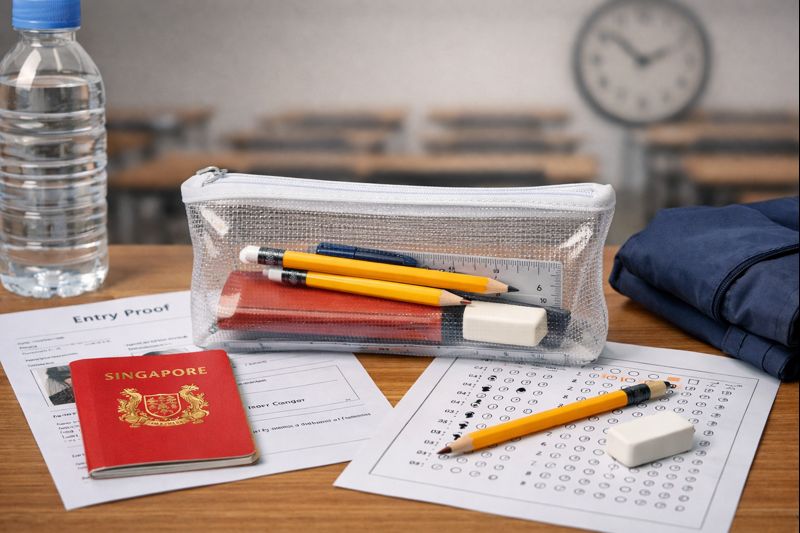
- Bring the core trio: Entry Proof, passport, permitted stationery. Entry Proof is retrieved from SEAB’s Candidates Portal about two weeks before the test and shows date, time, and venue.
- Know the rules: Calculators are not allowed for Mathematics. Follow the instructions on your Entry Proof and all venue rules.
- Arrive early: Plan to be on site well before the start so identity checks and seating can be completed calmly.
- Expect an orderly process: You apply via MOE, test with SEAB in Singapore, and receive outcomes and placement steps through official channels.
What to bring for AEIS exam day and what to expect
On the AEIS exam day, being well-prepared is essential for success. Think in layers. Documents first, then stationery, then comfort items that do not break rules. This exam-day readiness works best when aligned with the official Understanding the AEIS Exam Guide in Singapore so expectations are clear well before test day.
Documents you must have
Printed Entry Proof from SEAB’s Candidates Portal. You will receive an email about two weeks before the tests telling you to log in and download it. The Entry Proof lists your papers, timing, and venue.
Passport that matches the details on your Entry Proof. Invigilators check particulars against this document.
Any extra instructions printed on the Entry Proof or in the candidate email. If a document is listed there, bring it. Parents often miss small details highlighted in AEIS key dates and deadlines, so double-check timelines.
Stationery that is commonly permitted
Pencils, typically 2B for optical answer sheets, plus a clean eraser and a ruler. These are standard for SEAB-style MCQ papers. Always defer to the stationery list on your Entry Proof.
Transparent pencil case if you have one. This makes door checks faster. Practising with official formats from AEIS sample papers and practice tests helps students become comfortable with OAS shading and layout.
Items to leave at home
Calculators for Mathematics. They are not allowed under AEIS rules.
Devices with recording or communication capability. If you must bring a phone, switch it off and store it as instructed.
Correction fluid and any unapproved stationery if the Entry Proof prohibits them. These rules often catch students who have not reviewed AEIS exam day requirements and expectations carefully.
Comfort items that are usually acceptable
A labelled water bottle, unless the venue prohibits bottles in the room.
A light jacket, rooms can be cold.
Quick rule, if an item is not listed on the Entry Proof and you do not need it to write, do not bring it into the room.
Arrival and venue routine
AEIS is centrally administered by SEAB in Singapore. Venues, rooms, and reporting times are printed on your Entry Proof. Families preparing through AEIS tuition centres in Singapore often simulate this routine in advance to reduce anxiety.
Plan your timeline
Arrive early. Aim to be at the venue well before candidate instructions begin. This gives you buffer for queues, identity checks, and seating.
Follow signage to candidate reporting points, then show Entry Proof and passport upon request.
Listen to the briefing. Invigilators will read out rules, collect any declarations, and direct you to stow personal belongings.
Inside the room
Place only permitted stationery on the desk.
Keep your Entry Proof and passport ready for spot checks.
Do not write until told to begin.
If you need assistance, raise your hand and wait silently.
AEIS exam day rules and how they work in practice
Identity and Entry Proof
The Entry Proof is your pass. Without it you risk delays or being refused entry. Retrieve and print it in advance, then check that your particulars match your passport. This aligns with guidance explained in AEIS FAQs: answers to less-covered questions.
Mathematics calculators policy
Calculators are not allowed. You must show full workings in written sections. Prepare with mental arithmetic and written algorithms, especially if following the AEIS format and syllabus breakdown for Secondary or AEIS Primary format and syllabus guide.
Electronic devices
Phones and smartwatches must be powered off and stored as instructed. Do not keep them on your person once the paper begins.
What to expect from start to finish
You will recognise a predictable flow at every test venue.
Before the paper
Entry check with Entry Proof and passport. Seating by candidate number.
Invigilators brief you on timing, the use of pencils for the optical answer sheet, and how to fill in candidate particulars.
During the paper
The clock is visible. Invigilators announce final minutes.
For Mathematics, expect MCQ followed by short-answer or open-ended sections depending on level. Showing method is critical, a point reinforced in avoiding AEIS common mistakes for exam success.
For Secondary English, expect a writing section and a comprehension plus language section. Reviewing AEIS English test paper examples beforehand helps students pace themselves.
After the paper
Stop writing when told, then remain seated while scripts are collected.
Wait for dismissal. Collect belongings from the holding area as instructed, exit calmly.
How exam day connects to the bigger process
Remember that AEIS is a system, not just a test day. You apply through MOE’s application page, sit tests administered by SEAB, then check MOE for outcomes and placement steps. This full journey is explained clearly in the AEIS 2025 Singapore guide for school entry and the comparison article on AEIS vs S-AEIS.
Practical time management on the day
The two-pass method keeps nerves down and marks up.
Pass 1, secure marks
For Mathematics, sweep MCQ quickly, skip time traps, then in written sections start with questions from your strongest strands.
For English, pick a writing topic within five minutes, draft a quick plan, and begin.
Pass 2, quality and recovery
For Mathematics, box answers, add units, and check that the magnitude makes sense.
For English, check tense and agreement, replace vague words with precise ones, confirm that each paragraph answers the task. These habits are reinforced through AEIS mock tests in Singapore and structured revision using a comprehensive 3-month AEIS study plan.
FAQ, AEIS exam day rules and documents
Q: Where do I find venue and timing details
A: They are printed on your Entry Proof, which you retrieve from SEAB’s Candidates Portal after you receive the notification email, usually about two weeks before the tests.
Q: Is a calculator allowed for the Mathematics paper
A: No. Calculators are not allowed. Prepare to show full workings in written sections.
Q: What if the name or passport number on my Entry Proof is wrong
A: Contact SEAB promptly through the portal, then bring your passport to the venue early so invigilators can advise you. Your particulars must match official records.
Q: Can I bring my phone into the room
A: You may bring it to the venue, however it must be powered off and stored as instructed. Do not keep it on your person once the paper begins.
Q: What happens after exam day
A: Wait for outcome instructions on MOE’s site. Placement, if successful, is based on vacancies and is not a school of choice guarantee.
Disclaimer
This article is a general guide. Requirements, formats, fees and timelines can change. For the most accurate and current information, refer to the official sites below.