



5 Common Myths About Learning AI (You Don’t Need to Be a Math Genius)
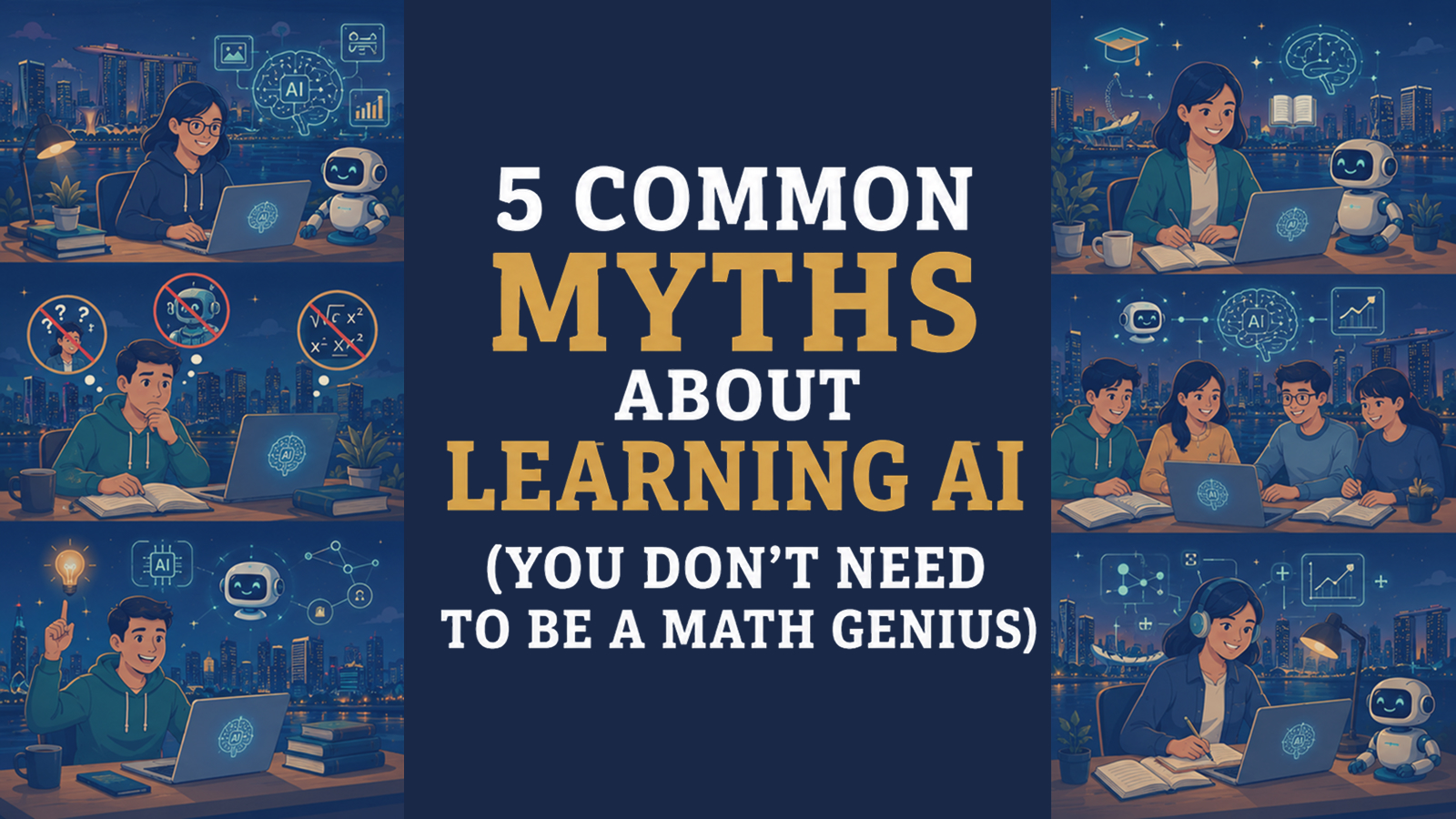
Table of Contents

TL;DR: 5 Common Myths About Learning AI
- You don’t need to be a math genius to start learning AI—beginners can build skills step by step.
- AI includes various learning paths, from programming and data analysis to business applications and AI tools.
- Practical skills, curiosity, and hands-on experience are just as important as mathematical ability.
- United Ceres College offers AI-related programmes that introduce relevant concepts and applications through the programme curriculum.
Many people are interested in learning artificial intelligence (AI) programs, but they hesitate because they believe it is only for mathematicians or computer scientists. One of the most common questions beginners ask is, “Do I need to be a math genius to learn AI?”
The short answer is no. (5 Common Myths About Learning AI (You Don’t Need to Be a Math Genius) While mathematics plays an important role in some areas of AI, most beginners do not need advanced mathematical knowledge to start learning. In fact, many people begin by understanding AI concepts, learning basic programming, and exploring practical applications before studying more technical topics. Whether you are an international student considering studying in Singapore, a working professional looking to develop new skills, or someone simply curious about AI, understanding the truth behind these common myths can help you begin your learning journey with confidence.
What Is Artificial Intelligence?
Artificial intelligence refers to computer systems that are designed to perform tasks that normally require human intelligence. These tasks may include recognizing images,
understanding language, making predictions, recommending products, or answering questions. Career opportunities in AI are already growing because AI is already part of everyday life. You may use AI without even realizing it when you:
- Receive movie recommendations on streaming platforms
- Use voice assistants on your phone
- Translate languages online
- Filter spam emails
- Navigate using map applications
Rather than being a single technology, AI includes different methods and tools that allow computer systems to analyse information and generate outputs such as predictions, recommendations or classifications.
Why Do So Many People Think AI Is Difficult?
AI often appears complicated because people associate it with advanced mathematics, coding, and complex algorithms. This impression is understandable. News articles frequently discuss machine learning models, neural networks, and data science without explaining that beginners usually learn the fundamentals first. Just as someone learning to drive does not begin by building a car engine, AI students typically start with basic concepts before progressing to more advanced topics.
5 Common Myths About Learning AI :
Myth 1: You Need to Be a Math Genius
The Reality
This is perhaps the biggest misconception about learning AI. Although advanced AI research involves mathematics such as calculus, linear algebra, and statistics. Many beginners do not need to master these subjects before beginning an introductory programme.
The amount of mathematics required depends on the learning pathway. Using AI tools or studying business applications may require less mathematics than developing machine-learning models or pursuing advanced AI research.
Many introductory AI programs focus on:
- AI concepts
- Problem-solving
- Basic programming
- Data interpretation
- Practical applications
- Ethical use of AI
As students progress, mathematical concepts are introduced gradually and explained within context.
Real-Life Example
Imagine a marketing executive who wants to use AI tools to analyze customer behavior. They may not need to calculate complex equations themselves. Instead, they learn how AI interprets customer data and how to use AI-powered software to make informed business decisions.
Myth 2: AI Is Only for Computer Science Students
The Reality
AI is becoming relevant across many industries, not just technology. Professionals from different backgrounds are exploring AI to improve productivity and solve real-world problems. Examples include:
- A pharmacist may use AI tools to help analyze medication data or identify patterns in patient information.
- Teachers creating personalised learning materials
- Financial analysts identifying market trends
- Retail businesses improving inventory management
- Human resource teams screening job applications
- Marketing professionals analysing customer preferences
This means students studying business, healthcare, finance, communications, engineering, and many other disciplines may also benefit from learning AI.
Real-Life Example
A pharmacist may use AI tools to help analyze medication data or identify patterns in patient information. While AI does not replace healthcare professionals, it may support better decision-making when used responsibly.
Myth 3: You Must Become an Expert Programmer First
The Reality
Programming is useful for many AI careers, but beginners do not need years of coding experience before learning AI. Many introductory courses begin with simple programming concepts and gradually build practical skills. Today, there are also AI platforms that require little or no coding, allowing learners to focus on understanding how AI works before writing complex programs. This makes AI more accessible than many people expect.
Skills Beginners Often Learn First
- Basic programming
- Data organisation
- Logical thinking
- AI fundamentals
- Problem-solving
- Responsible AI practices
These foundational skills provide a solid starting point before tackling more advanced topics. The amount of programming required depends on whether the learner intends to use existing AI tools, develop AI applications or build models from scratch.
Myth 4: Learning AI Means Building Robots
The Reality
Robotics is only one area where AI is used. Many AI professionals never work with robots at all. Instead, they develop systems that analyze information, automate repetitive tasks, or improve decision-making.
Real-Life Applications of AI
| Industry | How AI May Be Used |
| Healthcare | Supporting diagnosis and analysing medical images |
| Education | Personalised learning recommendations |
| Finance | Detecting unusual transactions |
| Retail | Product recommendations and inventory forecasting |
| Customer Service | AI chatbots answering common questions |
| Marketing | Analysing customer behaviour and campaign performance |
These examples show that AI is relevant in many professional settings beyond robotics.
Myth 5: AI Will Replace Every Job
The Reality
AI is changing the way many jobs are performed, but it is not replacing every profession. Instead, many organizations use AI to automate repetitive tasks while employees focus on work requiring creativity, communication, judgment, and collaboration. As AI adoption continues, many roles may evolve rather than disappear completely.
Real-Life Example
A customer service representative may use AI to draft responses to common questions. However, complex situations that require empathy and critical thinking still depend on human employees.
Learning how to work alongside AI may become an increasingly valuable skill across different industries.
Common Misconceptions About Learning AI
Many beginners worry about challenges that are often less significant than they appear.
“I’m too old to learn AI.”
People of different ages are learning AI to support career development or personal interests. Motivation and consistent practice are often more important than age.
“I need an expensive computer.”
Many beginner AI tools and cloud-based platforms run through a web browser, making them accessible without high-end equipment.
“I’ll never understand AI.”
Like learning a new language or musical instrument, AI becomes easier through regular study and practice.
“Only technology companies use AI.”
Today, businesses across healthcare, education, manufacturing, logistics, finance, hospitality, and government are exploring AI applications.
What Skills Help You Learn AI?
You do not need to know everything before starting. Instead, beginners may benefit from developing the following skills:
- Curiosity
- Logical thinking
- Problem-solving
- Basic computer literacy
- Communication
- Willingness to learn
- Attention to detail
Programming and mathematics can be learned gradually as students become more comfortable with AI concepts.
How Can Beginners Start Learning AI?
Starting with manageable steps often makes learning feel less overwhelming. A practical approach may include:
- Learn what AI is and where it is used.
- Understand basic programming concepts.
- Explore beginner-friendly AI tools.
- Practice with simple projects.
- Study data fundamentals.
- Learn about responsible and ethical AI.
- Continue building knowledge through structured learning.
Consistency is usually more effective than trying to learn everything at once.
Why Learning AI Matters Today
AI is influencing how organizations analyze information, improve services, and automate routine work. As a result, understanding AI may help students develop digital skills that are increasingly relevant in many industries. Depending on individual qualifications, interests, and career goals, AI knowledge may support opportunities in areas such as the following:
- Business
- Healthcare
- Marketing
- Finance
- Logistics
- Education
- Data analysis
- Customer experience
- Technology
Individual career outcomes will vary based on education, experience, and employer requirements.
Learning AI Through Practical Education
Choosing an AI program involves more than simply looking at course titles. Prospective students may wish to compare:
- Programme structure
- Learning outcomes
- Practical projects
- Entry requirements
- Assessment methods
- Student support
- Industry relevance
At United Ceres College, relevant AI programmes introduce learners to AI concepts and practical applications according to the published curriculum. Depending on the selected programme, students may study areas such as programming fundamentals, data handling, AI applications and responsible AI. Depending on the program structure, students may explore AI concepts, programming fundamentals, and practical applications that prepare them for continued learning and professional development.
Final Thoughts
Learning AI programs as a beginner is often more accessible than many people expect. While advanced mathematics and programming play an important role in specialized AI careers, they are not barriers that prevent beginners from getting started. The most important qualities are curiosity, persistence, and a willingness to learn step by step. By understanding the common myths surrounding AI, students can make informed decisions about their education and choose learning pathways that match their interests and career goals. If you are considering studying AI, taking time to explore program structures, learning outcomes, and entry requirements can help you select an educational pathway that supports your long-term aspirations.
Frequently Asked Questions (FAQs)
1. Do I need advanced mathematics to start learning AI?
No. Many beginner AI programs introduce concepts gradually. Advanced mathematics becomes more important for specialized areas of AI but is not always required when starting.
2. Can someone without a computer science background learn AI?
Yes. Students from business, healthcare, education, finance, and many other fields may explore AI depending on their interests and career goals.
3. Is programming required for AI?
Programming is useful for many AI roles, but beginners often learn programming step by step. Some AI tools also require little or no coding.
4. What careers may benefit from AI knowledge?
AI skills may be relevant across industries, including healthcare, finance, marketing, retail, education, logistics, and technology. Career opportunities depend on individual qualifications, experience, and employer requirements.
5. Is AI difficult to learn?
Like any new subject, AI requires time and practice. Beginning with fundamental concepts and progressing gradually can make the learning process more manageable.
6. How can I choose the right AI program?
Compare programme content, learning outcomes, practical projects, entry requirements, and teaching approaches. Selecting a program that matches your goals and learning preferences can help you build a strong foundation for future study and career development.