



Understanding Database Basics: Why AI Professionals Benefit From Data Storage
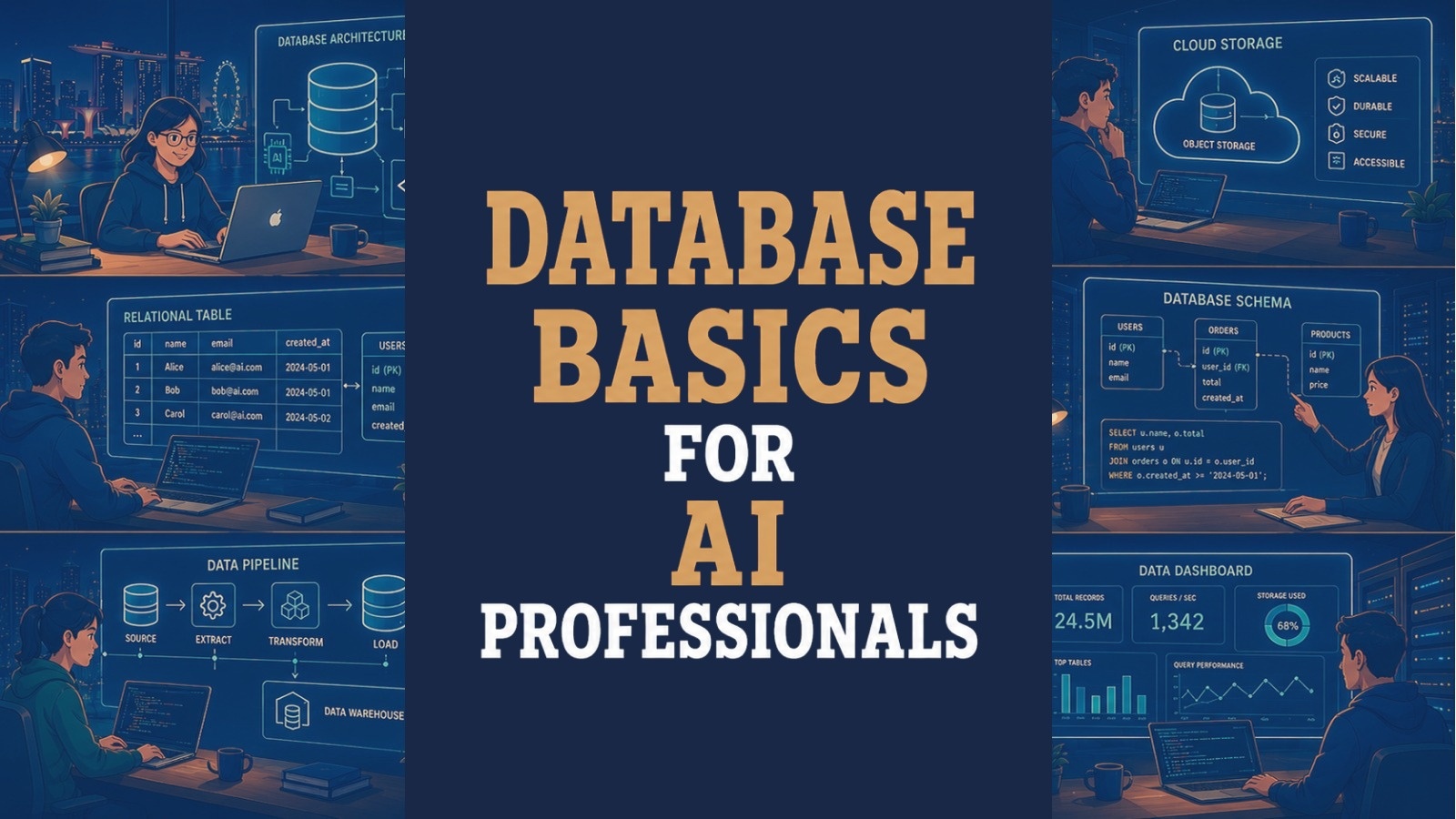
Table of Contents


TL;DR: Understanding Database Basics
- Database basics are important for AI professionals because artificial intelligence systems depend on data to train models, generate insights, and support decisions.
- AI professionals do not always need to become database administrators, but understanding how data is stored, organized, accessed, and protected can make AI projects more practical and reliable.
- Knowledge of databases can help AI professionals work more effectively with developers, data engineers, and business teams when building or improving AI applications.
- At United Ceres College, practical learning can help students explore AI concepts alongside the digital and technical foundations needed to understand how AI systems work in real-world environments.
Data plays a central role in many AI systems, from model development and evaluation to retrieval, analysis and application workflows. An AI model can analyze customer information, identify patterns in medical records, recommend products, or generate useful predictions, but it needs access to relevant data first. That data has to be collected, organized, stored, retrieved, and managed properly. This is where databases become important.
You do not necessarily need to become a database administrator to work in AI. However, understanding database basics can help you understand what happens behind an AI system and communicate more effectively with technical teams. For students and professionals entering AI, learning how data is stored is therefore more than a technical extra. It is part of understanding the wider AI ecosystem.
What Is a Database?
A database is an organized system used to store and manage information so that it can be accessed and updated when needed. Think about a university storing student information. Its database might contain:
- Student names
- Registration numbers
- Courses
- Grades
- Attendance records
- Contact information
Instead of keeping all this information in separate paper files, a database provides a structured way to manage it.
Businesses use databases for many similar purposes. An online retailer, for example, may store information about:
- Customers
- Products
- Orders
- Payments
- Inventory
AI systems can then use appropriate data from these databases for analysis, automation, recommendations, or other applications.
Why Does Data Storage Matter for AI?
AI systems rely on data in different ways. Machine learning models may be trained on data to identify patterns, while deployed AI applications may retrieve or process stored data to perform specific tasks. Consider an online shopping platform that wants to recommend products. The system may need information about:
- Previous purchases
- Products viewed
- Search history
- Customer preferences
- Product categories
Poorly organised, incomplete, outdated or inaccessible data can reduce the usefulness or reliability of downstream analysis and recommendations. This is why AI professionals need to understand the relationship between data storage and AI performance. The performance and usefulness of many AI applications depend not only on the model being used but also on the relevance, quality, accessibility, and management of the underlying data.
How Databases Support AI Projects
Databases can support AI projects at several stages.
Collecting Data
AI applications often work with large amounts of information gathered from different sources. For example, a business might collect the following:
- Customer interactions
- Website activity
- Sales transactions
- Product information
- Survey responses
Databases are one common way to store and manage structured information.
Retrieving Data
An AI application may need specific information at a particular moment. For example, a customer service AI assistant may need to retrieve a customer’s order status before responding. The system could access the relevant information from a database and use it to provide an appropriate response.
Updating Data
Business information changes constantly. A product may go out of stock. A customer may change their address. A new transaction may be recorded. Databases allow information to be updated without rebuilding the entire system.
Supporting Analysis
AI professionals may also use stored data to identify trends and patterns. For example, a retail company could analyze historical sales data to understand which products perform better during different seasons. This information could then support forecasting or machine learning projects.
Types of Databases AI Professionals Should Know
There are many database technologies, and beginners do not need to master every type. However, understanding the main categories can provide a useful foundation.
Relational Databases
Relational databases organize information into tables containing rows and columns. A customer table, for example, might contain:
| Customer ID | Name | Country | Order Count |
| 1001 | Sara | Singapore | 12 |
| 1002 | Daniel | Malaysia | 8 |
| 1003 | Aisha | Indonesia | 15 |
Different tables can be connected using relationships. Relational databases are widely used for structured business information and are an important concept for AI professionals to understand.
SQL
SQL stands for Structured Query Language.
It is commonly used to interact with relational databases. For example, an AI professional might use SQL to retrieve information about customers who made purchases during a particular period.
You do not necessarily need advanced SQL knowledge to begin working with AI, understanding basic queries can be useful when working with structured datasets.
What Is NoSQL?
NoSQL databases use approaches that differ from traditional relational databases. They can be useful for certain types of information and applications where flexible data structures or large-scale data handling are important. Common NoSQL approaches include:
- Document databases
- Key-value databases
- Graph databases
- Wide-column databases
For beginners, the main takeaway is simple: different data structures can require different storage approaches. The choice depends on factors such as the type of data, application requirements, scale, and how the information needs to be accessed.
Structured vs Unstructured Data
AI professionals also need to understand the difference between structured and unstructured data.
Structured Data
Structured data follows an organized format.
Examples include:
- Customer tables
- Sales records
- Employee databases
- Inventory lists
This type of information can often be easily organized into rows and columns.
Unstructured Data
Unstructured data does not naturally fit into the traditional rows-and-columns structure commonly associated with relational databases. Examples include:
- Images
- Videos
- Audio recordings
- Emails
- Social media posts
- Documents
Modern AI systems increasingly work with these forms of information. For example, a computer vision system may analyse images, while a natural language processing system may process text.
Example Scenario: AI in Retail
Imagine an online clothing company wants to build an AI recommendation system. The organization has years of customer information stored in databases. The data includes:
- Previous purchases
- Product searches
- Customer preferences
- Product ratings
- Browsing behaviour
An AI team could analyse this information to develop a recommendation system. But before building the model, the team needs to understand the data.
Are there duplicate records? Are some fields missing? Are product categories consistent? Is old information still relevant? These questions demonstrate why database and data-management knowledge matters. The AI model is only one part of the project. The quality and organisation of the underlying data also matter.
Database Basics AI Beginners Should Learn
You do not need to master database administration to benefit from database knowledge. A beginner can start with several fundamental concepts.
Tables
Understand how structured information can be organized into tables.
Rows and Columns
Learn how individual records and attributes are represented.
Primary Keys
Understand how unique identifiers can distinguish one record from another.
Relationships
Learn how different tables can connect related information.
Queries
Understand how users retrieve specific information from databases.
Data Types
Become familiar with common types such as text, numbers, dates, and Boolean values.
Data Integrity
Understand why information needs to remain accurate and consistent. These concepts provide a foundation for working with larger AI and data projects.
Why Data Quality Matters to AI
One of the most important lessons for an AI professional is that more data does not automatically mean better AI. Imagine a company has one million customer records.
That sounds impressive. But suppose:
- 20% contain missing information.
- Some customers appear multiple times.
- Dates are recorded in different formats.
- Product categories are inconsistent.
- Some records contain outdated information.
Simply feeding this data into an AI system may not produce reliable results. This is why data preparation is such an important part of many AI projects.
What Is Data Cleaning?
Data cleaning involves identifying and addressing quality issues within a dataset. Depending on the project, this may involve:
- Removing duplicate records.
- Handling missing values.
- Correcting inconsistent formats.
- Identifying unusual entries.
- Standardizing information.
For example, imagine a dataset records the same country in three different ways:
- Singapore
- SG
- Singapore, SG
An AI system may treat these as different categories unless the data is standardized. Cleaning the information can make analysis more consistent.
Databases and Machine Learning
Machine learning projects often require historical data. Suppose a company wants to predict whether customers are likely to cancel a subscription. The AI team might use historical information about the following:
- Customer activity
- Subscription length
- Previous cancellations
- Support interactions
- Purchase history
This information may come from one or more databases. The data can then be prepared for use in a machine learning workflow. A simplified machine learning workflow might look like this:
Database → Data Preparation → Dataset → Machine Learning Model → Prediction
Understanding this flow helps AI professionals see how different parts of an AI project connect.
Database vs Data Warehouse vs Data Lake
These terms can sound confusing to beginners. While the exact architecture varies between organisations, the concepts can be understood simply.
| Data System | General Purpose |
| Database | Stores information used by applications and business systems. |
| Data warehouse | Typically consolidates data from multiple sources for analytics, reporting and business intelligence. |
| Data lake | Can store large volumes of structured and unstructured data for different uses. |
An AI professional does not necessarily need to design these systems, but understanding what they are used for can make collaboration with data teams much easier.
Why AI Professionals Benefit From Database Knowledge
Understanding data storage can help AI professionals in several practical ways.
Communicating With Technical Teams
AI projects often involve developers, data engineers, analysts, and business professionals. Knowing basic database concepts makes it easier to discuss:
- Where data is stored.
- How it can be accessed.
- What information is available.
- How datasets are structured.
Planning AI Projects
Suppose someone proposes building an AI system to predict customer behaviour. A person with database knowledge may immediately ask the following:
- Do we have enough historical data?
- Where is the data stored?
- Is it structured consistently?
- Can we access it?
- Are there privacy restrictions?
These questions can identify potential problems before development begins.
Understanding Data-Related AI Limitations
Sometimes the problem is not the AI model. The problem may be the data. If an organization has incomplete or unreliable information, even a technically sophisticated model can produce unreliable or limited outputs when the underlying data is incomplete, irrelevant or poorly managed. Understanding databases helps professionals recognize these limitations.
What Should Beginners Learn First?
If you’re new to AI and databases, don’t try to learn everything at once. A practical learning path could look like this:
- Understand what databases are.
- Learn tables, rows, columns, and relationships.
- Explore basic SQL.
- Understand structured and unstructured data.
- Learn about data cleaning.
- Explore how databases connect to AI workflows.
- Practice working with simple datasets.
Once these concepts become familiar, you can gradually explore more advanced areas such as cloud databases, data warehouses, data lakes, and vector databases.
Common Misconceptions About Database Knowledge for AI
“AI Professionals Need to Become Database Administrators”
Not necessarily. AI professionals need enough database knowledge to understand how data is stored, accessed, and prepared. Database administration is a specialised role with responsibilities that go beyond the database fundamentals many AI professionals may need.
“AI Models Store Everything in a Database”
AI models and databases serve different purposes. A database primarily stores and manages information, while an AI model processes information to perform tasks such as prediction, classification, or generation. AI applications may use databases as part of a larger system.
“Only Data Scientists Need Database Knowledge”
Database knowledge can benefit many AI-related professionals, including developers, analysts, automation specialists, and business professionals working with AI projects.
“Big Data Automatically Creates Better AI”
Large datasets can be useful, but quality, relevance, accuracy, and appropriate preparation also matter. More information is not automatically better information.
How AI Professionals Can Build Database Skills
You do not need to start with advanced database architecture. Beginners can build their skills through small practical exercises. For example, create a simple database containing information about products, customers, or books.
Then practise:
- Adding records.
- Updating information.
- Searching for specific records.
- Connecting related tables.
- Running basic SQL queries.
- Identifying duplicate or missing data.
These exercises can help make abstract concepts easier to understand.
Building an AI Foundation With United Ceres College
For learners who want to build foundational knowledge in artificial intelligence and related technical areas, United Ceres College offers the Diploma in Applied Artificial Intelligence (AI).
The programme includes modules such as Database Application Development, alongside Computational Thinking, Logic & Mathematics, Data Structures & Algorithms, Machine Learning for Developers, and User Experience & Interface Design.
Learners considering the programme should review the current curriculum, entry requirements, assessment methods, and learning outcomes to understand whether it aligns with their educational goals.
Final Thoughts
Artificial intelligence may be the visible part of many modern technology systems, but data storage is one of the foundations underneath it. Understanding databases helps AI professionals see where information comes from, how it is organized, how it can be accessed, and why data quality matters before it reaches an AI model. You do not need to become a database expert to work in AI. However, learning Database Basics can make it easier to understand AI workflows, communicate with technical teams, identify data-related problems, and build more realistic expectations about what AI systems can achieve. If you are beginning your AI journey, consider learning databases alongside AI fundamentals, programming, data literacy, and problem-solving.
Frequently Asked Questions (FAQs)
1. Do AI professionals need to know databases?
They do not necessarily need advanced database expertise, but understanding database fundamentals can help AI professionals work with data, communicate with technical teams, and understand how AI applications are built.
2. Should I learn SQL before studying AI?
Learning basic SQL can be useful, particularly if you expect to work with structured data. However, it is not always a prerequisite for beginning AI studies.
3. What database concepts should an AI beginner learn?
Start with tables, rows, columns, primary keys, relationships, queries, data types, and data quality. Basic SQL is also useful.
4. How are databases used in AI?
Databases can store information that AI applications use for analysis, predictions, recommendations, automation, and other tasks. They may form one part of a larger AI architecture.
5. Is database knowledge useful for machine learning?
Yes. Machine learning projects often require historical datasets, and these datasets may be stored in databases or other data systems before being prepared for model training or analysis.
6. Can I learn databases without a programming background?
Yes. Beginners can start with basic database concepts and gradually learn SQL. You do not need to become an experienced programmer before understanding how databases work.