



Who Is Eligible for AEIS? Age, School Level and Application Requirements
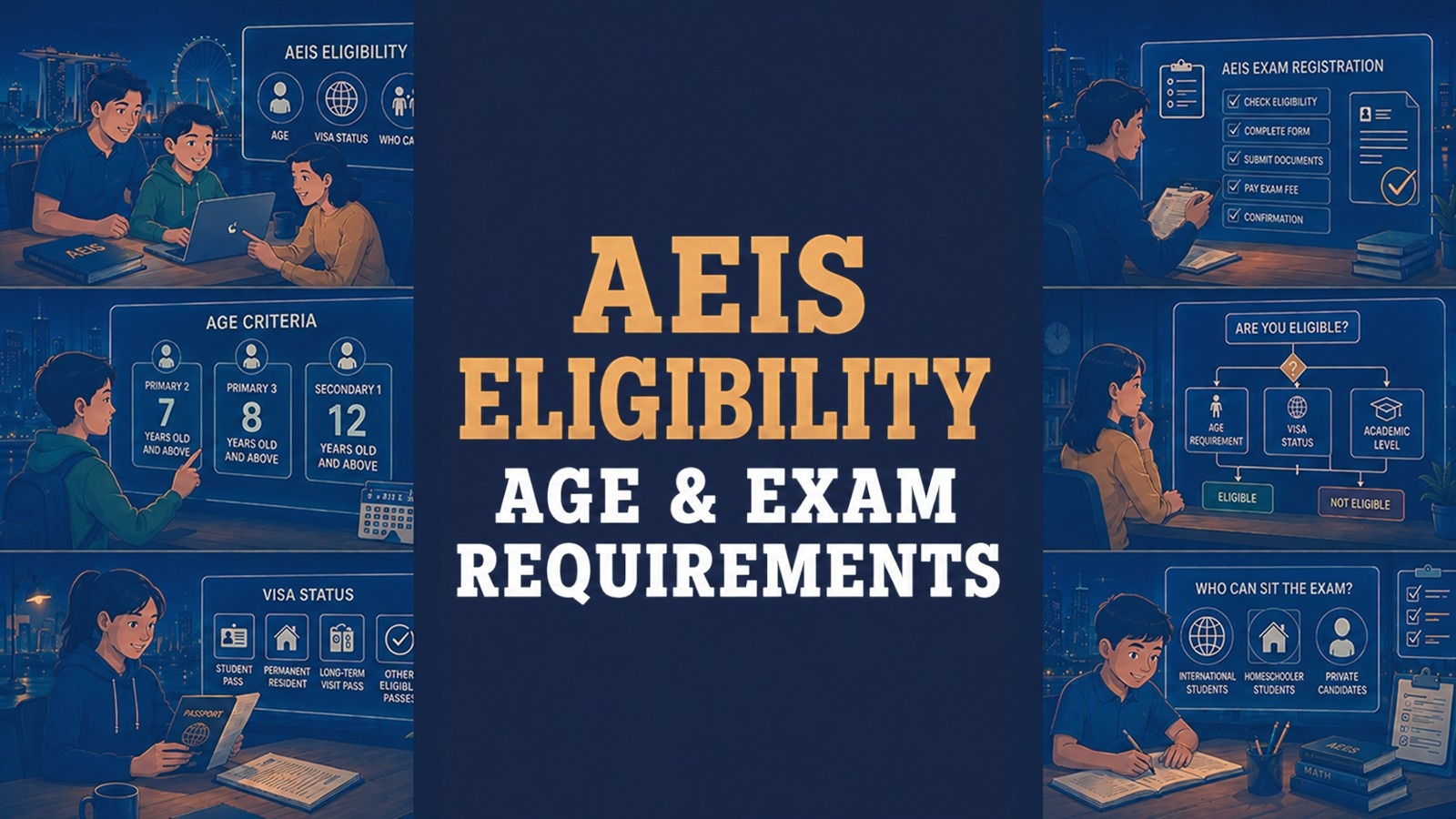
Table of Contents


TL;DR: Who Is Eligible for AEIS?
- AEIS is an entrance examination for eligible international students who wish to apply for admission to Primary 2 to 5 or Secondary 1 to 3 in Singapore MOE mainstream schools. Meeting the application requirements does not guarantee admission. Admission is subject to the student’s performance in the relevant test or tests, and successful applicants are placed according to available school vacancies and, where possible, their declared residential area.
- A student’s age is important because it determines the appropriate AEIS test level and potential school placement. Primary applicants must also meet the required Cambridge English Qualifications score before applying for the AEIS-Primary Mathematics test. Families should separately review passport, application, and immigration requirements relevant to their circumstances.
- Preparing well before the application period may improve a student’s readiness for the relevant AEIS assessment requirements. Checking the latest eligibility requirements is equally important because policies may change over time.
Who Is Eligible for AEIS?
Many parents and international students who hope to study in Singapore ask the same question: Who is eligible to take the AEIS exam? The answer involves more than simply meeting an age requirement. Previous education can be useful when determining a suitable preparation level and assessing academic readiness. Families should distinguish between the entry requirements of an AEIS preparatory course and MOE’s official eligibility requirements for the AEIS exercise. Understanding these requirements early can save time, reduce confusion, and help families prepare the right documents before the application window opens.
The Admissions Exercise for International Students (AEIS) is an entrance examination that allows eligible international students to apply for admission to selected Singapore mainstream primary and secondary schools. Instead of applying directly to a school, students first sit for the AEIS examination. Their performance, combined with available school places, helps determine whether they may be offered admission.
The AEIS assessment requirements differ between Primary and Secondary applicants. For Primary 2 to Primary 5 admission, applicants must meet the required Cambridge English Qualification (CEQ) standard and sit the AEIS Mathematics test. Secondary applicants are assessed in English and Mathematics.
These English-language and Mathematics requirements help determine whether applicants meet the relevant academic and assessment expectations for their intended level. It is important to remember that sitting for the AEIS does not guarantee admission. School posting depends on the applicant’s test performance, available vacancies and MOE’s applicable posting criteria.
Why Does AEIS Eligibility Matter?
Many families focus on preparing for the examination itself but overlook whether the student actually qualifies to apply. IImagine spending months preparing for the applicable CEQ and/or AEIS assessment requirements, only to discover that the student does not meet the age or application criteria. Understanding the criteria early helps families avoid unnecessary stress and prepare with confidence. Checking eligibility beforehand can help you:
- Plan your application timeline.
- Gather the required documents.
- Understand suitable school levels.
- Avoid submitting an ineligible application.
- Prepare for future admission opportunities if needed.
Who Can Sit the AEIS Exam?
Not every international student can apply for AEIS. The examination is designed for students who meet specific eligibility requirements established by Singapore’s education authorities. In general, families should check factors such as:
- the student’s age;
- whether they meet the definition of an eligible international student;
- the school level available through the relevant AEIS exercise;
- the applicable CEQ requirement for Primary applicants;
- the current application and document requirements.
Let’s look at each requirement in more detail.
Age Requirements for AEIS
Why Is Age Important?
Singapore places students into school levels based largely on their age. This helps ensure that students learn alongside classmates with similar educational and developmental backgrounds. Rather than allowing students to choose any grade, applicants are assessed for a level that matches the official age guidelines. For example, if a student is significantly older or younger than the expected age for a particular level, they may not qualify for admission through AEIS.
General Age Expectations
While specific age ranges can vary depending on the admission year and school level, students typically apply for admission into the following:
- Primary school
- Secondary school
Each level has its own acceptable age range. For instance, a student hoping to enter Primary 4 should generally fall within the age range specified for that level during the year of admission. Parents should always verify the latest age requirements before applying because they may be updated.
Hypothetical Example
Consider two students applying for the same school level.
Student A falls within the official age range published by MOE for that level in the relevant admission year. Their age is therefore consistent with the eligibility requirements for the intended school level.
Student B falls outside the published age range for the same level. Even if the student is academically capable, they may not be eligible to apply for that level through AEIS.
This example shows why families should check the latest AEIS age requirements and school-level criteria before beginning the application or preparation process.
Who Is Considered an International Student for AEIS?
One common misconception is that AEIS is available only to students from certain countries. In reality, the examination is intended for international students from many different nationalities, provided they satisfy the official eligibility requirements. Nationality alone usually does not determine whether a student qualifies. Instead, eligibility depends on whether all application requirements are met.
What About Immigration and Student Pass Arrangements?
School admission and immigration arrangements are separate processes. Eligible international students do not necessarily need to already be living in Singapore when they apply for AEIS. Families should review the immigration or Student’s Pass requirements that may apply if the student is subsequently offered a school place.
Why Visa Planning Matters
Imagine a family receives a school placement but delays preparing the necessary immigration documents. Even though the student has completed the admission process, administrative delays could affect when they are able to begin school. Planning allows families to better coordinate school admission, travel arrangements, and immigration requirements.
Previous Schooling and Academic Readiness
A student’s previous education can help families understand whether they are academically prepared for the school level they hope to enter. However, previous schooling should not be confused with MOE’s official AEIS eligibility requirements, which applicants should check separately for the relevant admission year and school level.
Students preparing for AEIS may benefit from reviewing how their previous curriculum compares with the knowledge and skills expected at their intended level in Singapore. Differences in curriculum, subject coverage, or learning pace may affect how much preparation a student needs before taking the relevant assessments.
Applicants should check the current official document requirements to determine whether previous school records or other educational documents are required for their application. Families should refer to the latest official requirements to confirm which documents are needed.
For students considering an AEIS preparatory course, the education provider may also have its own course admission requirements based on age, previous schooling, or academic background. These course entry requirements are separate from MOE’s eligibility requirements for AEIS.
Why Educational Background Matters
Imagine a student who has missed several years of formal education. Even if they meet the age requirement, they may find it challenging to adapt to Singapore’s curriculum because classmates have already covered important concepts. Reviewing previous education can help families understand whether additional academic preparation may be useful before the student enters a new curriculum.
Age vs. School Level: Understanding the Difference
Many parents assume they can simply choose the grade they believe suits their child.
However, Singapore’s education system generally follows structured placement guidelines. The following table highlights the difference.
| Factor | What It Means |
| Age | Helps determine which test or school level may be applicable. |
| Previous education | Can help assess academic readiness and preparation needs; this is separate from MOE’s official AEIS eligibility criteria. |
| English ability | Primary applicants meet the applicable CEQ requirement; Secondary applicants sit an AEIS English test. |
| Mathematics ability | Assessed through AEIS for both Primary and Secondary applicants. |
| School vacancies | Successful posting is subject to available places and applicable MOE posting criteria. |
These factors work together during the admission process, rather than relying on just one requirement.
Who May Not Be Eligible for AEIS?
Understanding who may not qualify for AEIS is just as important as knowing who can apply. This can help families avoid spending time and money on an application that may not meet the official requirements. A student may not be eligible if they:
- Do not fall within the required age range for the intended school level.
- Do not meet the eligibility requirements published for the relevant admission exercise.
- Apply for a school level that is not available through AEIS.
Remember that eligibility requirements may change over time, so families should always check the latest guidance before applying.
Who Is AEIS Suitable For?
AEIS is designed for international students who wish to join Singapore’s government school system and meet the published eligibility requirements. It may be suitable for:
- Children whose families are relocating to Singapore.
- Students already living in Singapore who are eligible to apply.
- Families seeking a structured public education pathway.
- Students who are comfortable studying in English.
- Students who are academically prepared for the assessment requirements applicable to their Primary or Secondary level.
Every student’s circumstances are different, so families should consider both academic readiness and personal goals before applying.
Hypothetical Example
Suppose Maya’s parents receive a work opportunity in Singapore. They want Maya to continue her education in a government school after moving. Before preparing for the AEIS examination, they first confirm:
- Maya’s age matches the intended school level.
- They review whether her previous education has prepared her academically for the intended level.
- They understand the visa and immigration process.
- They have enough time to gather supporting documents.
Because they planned ahead, they can focus on preparing for the examination instead of rushing through administrative requirements at the last minute.
What Documents May Be Required?
Although document requirements can vary depending on the application cycle, families are commonly asked to prepare documents that help verify the student’s identity and educational background. Depending on the current application requirements, documents may include:
- student passport biodata page;
- birth certificate;
- recent photograph;
- CEQ statement of results for Primary applicants;
- other supporting documents requested by MOE.
Applicants should refer to MOE’s current AEIS application instructions for the complete document list.
Why English and Mathematics Matter
Many students focus only on whether they are eligible but forget that eligibility alone is not enough. The AEIS examination is designed to assess whether students are academically prepared for Singapore’s curriculum.
English Requirements for AEIS Applicants
English is important because it is the main language of instruction in Singapore mainstream schools. However, the English requirement differs between Primary and Secondary AEIS applicants.
For Primary Applicants
Primary applicants do not sit a separate English paper as part of the AEIS examination. Instead, they must meet the required Cambridge English Qualification (CEQ) standard for the school level they are applying to before they can register for AEIS.
The Primary AEIS assessment itself focuses on Mathematics. Families should therefore check the latest CEQ score requirements published for the relevant admission year and school level.
For Secondary Applicants
Secondary AEIS applicants are assessed in both English and Mathematics. The English assessment evaluates whether students have the language skills needed to cope with learning in an English-medium school environment.
Depending on the level, students may need to demonstrate skills such as:
- Reading comprehension
- Vocabulary and language use
- Grammar
- Written expression
Strong English proficiency can also help students participate more confidently in classroom discussions, understand assignments, and adjust to academic learning after admission. Families should review MOE’s latest AEIS Secondary test information for the current English test format and content.
Mathematics Assessment
The Mathematics section evaluates whether students have the knowledge expected for their intended school level. Questions may assess:
- Arithmetic.
- Problem-solving.
- Logical reasoning.
- Mathematical concepts appropriate for the student’s age.
Rather than memorising formulas alone, students benefit from understanding how to apply mathematical concepts in different situations. Learners should still review MOE’s latest AEIS Secondary test information for the current English test format and content.
Common Challenges International Students Face
Moving to a new education system is exciting, but it also comes with challenges. Some students need time to adjust to:
Learning in English
Even students who understand conversational English may initially find classroom lessons, textbooks, or examinations more demanding. For example, solving a mathematics problem becomes more difficult if a student struggles to understand the wording of the question.
Different Teaching Styles
Teaching methods in Singapore may differ from those used in a student’s home country. Understanding these differences beforehand can help students adapt more confidently.
Managing the Transition
Starting at a new school also means adapting socially and emotionally. Students may need time to:
- Make new friends.
- Understand school routines.
- Build confidence in speaking English.
- Adjust to new classroom expectations.
Parents can support this transition by encouraging regular study habits and maintaining open communication with their child throughout the process.
Common Misconceptions About AEIS Eligibility
Many families hear conflicting information about AEIS. Let’s separate fact from fiction.
| Misconception | Reality |
| Only students already living in Singapore can apply. | Eligible international students may apply depending on the published admission requirements and their circumstances. |
| Passing AEIS guarantees admission. | Performing sufficiently well in the AEIS does not by itself guarantee a school place. Admission also depends on available vacancies and the applicable posting criteria. |
| Students can choose any grade they like. | School level generally follows age and eligibility guidelines. |
| Excellent grades automatically ensure success. | Academic preparation is important, but students must also satisfy eligibility requirements and achieve a sufficiently competitive assessment outcome for the relevant exercise |
| Visa approval and school admission are the same process. | School admission and immigration procedures are separate, although both may be necessary before a student begins school. |
Understanding these misconceptions can help families make informed decisions and avoid unnecessary disappointment.
Practical Tips Before Applying for AEIS
Good preparation starts long before the examination date. Consider the following steps:
Check Eligibility Early
Confirm your child’s age and intended school level before beginning the application.
Review Previous School Records
Ensure educational documents are complete and accurately reflect the student’s academic history.
Strengthen English Skills
Reading books, practising comprehension exercises, and writing short essays can help students become more comfortable using English.
Practise Mathematics Regularly
Consistent practice is often more effective than last-minute revision. Working through age-appropriate questions can help students identify areas that need improvement.
Prepare Documents in Advance
Gather passports, school records, certificates, and other required documents early so you are ready when applications open.
Stay Updated
Application procedures, eligibility criteria, and examination arrangements may change. Checking the latest information before applying can help families avoid relying on outdated guidance.
Do Students Need Special Coaching?
This is a common question among parents. The answer depends on the student’s individual needs. Some students already have a strong foundation in English and Mathematics and only require additional practice with question formats. Others may benefit from structured preparation if they are unfamiliar with Singapore’s curriculum or need extra support in certain subjects. The goal should not simply be to memorize answers but to build genuine understanding and confidence.
How Can Parents Support Their Child During AEIS Preparation?
Parents play an important role in helping children prepare for both the examination and the transition to a new education system. Here are a few practical ways to provide support:
Create a Consistent Study Routine
Instead of studying for long hours occasionally, encourage your child to follow a regular study schedule. Even 30–60 minutes of focused practice each day can help build confidence over time.
Encourage Reading in English
Reading storybooks, newspapers, or age-appropriate articles can improve vocabulary, comprehension, and overall language skills. For example, discussing an article together after reading helps children practice understanding and expressing ideas in English.
Focus on Understanding, Not Memorisation
Rather than memorizing answers, encourage your child to understand the concepts behind English and Mathematics questions. This approach is more useful when facing unfamiliar questions during the examination.
Build Confidence
Preparing for AEIS can sometimes feel stressful, especially for students moving to a new country. Celebrate progress, encourage questions, and remind your child that improvement comes with consistent practice.
Preparing for Life in a Singapore Government School
Success in AEIS is only the beginning. Students should also prepare for life in a new learning environment. They may experience:
- New classroom routines.
- Different teaching approaches.
- A multicultural student community.
- Different expectations around classroom participation and independent study.
- Opportunities to participate in school activities and teamwork.
Being mentally prepared for these changes can make the transition smoother and help students settle into school more comfortably.
Learning More About Singapore’s Education Pathways
Families often spend a great deal of time researching school admission requirements before deciding on the next step. Alongside understanding the AEIS process, it can also be helpful to explore different education pathways, foundation programs, language preparation courses, and skills-based learning opportunities available in Singapore. United Ceres College offers separate preparatory courses for Primary and Secondary AEIS applicants. The Primary programme includes CEQ-aligned English preparation alongside Mathematics preparation based on relevant Singapore MOE syllabi, while the Secondary programme prepares students for the English and Mathematics components of AEIS. Both courses are conducted face-to-face over six months and include teacher-led instruction, guided practice, topical reviews and exam-format exercises.
Prospective students should review UCC’s preparatory-course admission requirements separately from MOE’s official AEIS eligibility and application requirements.
Final Thoughts
Understanding AEIS eligibility is about much more than checking an age requirement. Families should first confirm MOE’s official eligibility requirements, including the student’s age and applicable school level. They should separately plan for supporting documents, academic preparation, and any immigration arrangements that may apply if the student is offered admission. Planning allows parents and students to prepare with greater confidence and reduces the likelihood of unexpected challenges during the application process. Although meeting the eligibility requirements is an important first step, school placement also depends on assessment performance and available school vacancies. Taking time to understand the process, strengthening academic skills, and organizing the necessary documents can help students approach the AEIS with realistic expectations.
Frequently Asked Questions (FAQs)
1. What is the minimum age for the AEIS exam?
The required age depends on the school level a student is applying for and the admission year. Students should check the latest published age requirements before submitting an application.
2. Can students living outside Singapore apply for AEIS?
Eligible international students do not necessarily need to be residing in Singapore at the time of application. Families should check MOE’s current application requirements and any applicable travel or immigration requirements.
3. Does passing the AEIS guarantee admission to a government school?
No. There is no guarantee of school placement based solely on an AEIS result. Posting depends on the applicant’s performance, eligibility and available school vacancies.
4. Is a Singapore visa required before applying?
Students do not necessarily need to already be residing in Singapore to apply for AEIS. School admission and immigration arrangements are separate processes, and families should check the applicable immigration requirements if the student is subsequently offered a school place.
5. Do students need excellent English to sit the AEIS?
English requirements differ by level. Primary applicants must meet the applicable CEQ requirement, while Secondary AEIS candidates sit an English assessment as part of AEIS. English proficiency is also important because English is the main medium of instruction in Singapore mainstream schools.
6. How can students prepare for the AEIS examination?
Students can prepare by working on the English-language and Mathematics requirements relevant to their level. Primary applicants should check the applicable CEQ requirement and prepare for the AEIS Mathematics test, while Secondary applicants should prepare for both AEIS English and Mathematics.