



AEIS Exam Difficulty Level Explained (Primary vs Secondary)
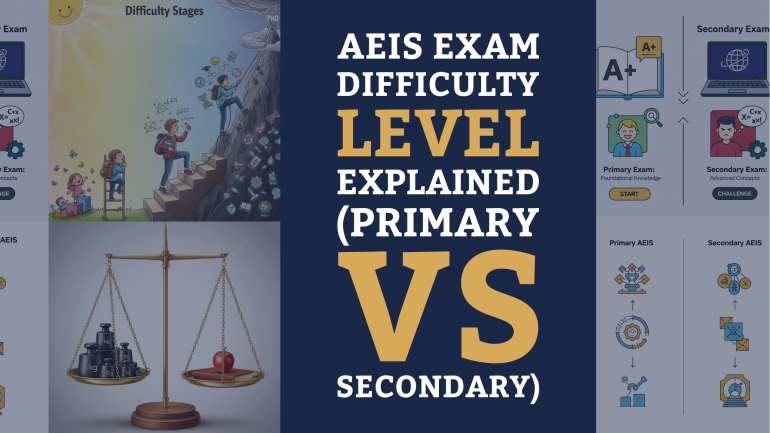
Table of Contents

TL;DR: AEIS Exam Difficulty Level Explained (Primary vs Secondary)
- AEIS isn’t hard because of content but because the style of questions focuses on application, logic, and English comprehension rather than memorization, which catches many students off guard.
- Primary AEIS is simpler academically, but language-heavy younger students struggle more with understanding instructions, word problems, and time pressure than with actual math difficulty.
- Secondary AEIS is more demanding and fast-paced; it requires stronger analytical skills, deeper English comprehension, and quick, accurate application of multiple concepts.
- Neither level is “easier” for everyone; difficulty depends on the child’s English proficiency, math foundation, prior curriculum, and ability to perform under exam pressure.
- Early, targeted preparation reduces difficulty significantly focusing on exam-style questions, English alongside Math, and timed practice turns confusion into confidence
AEIS Exam Difficulty Level Explained (Primary vs Secondary): What Parents Really Need to Know
If you’re researching the AEIS exam difficulty level, chances are you’re feeling a mix of curiosity, concern, and maybe a little anxiety. And honestly, that makes complete sense. Anytime an exam decides whether your child can enter Singapore’s public school system, the pressure automatically feels heavier. One of the most common questions parents ask is, “Is AEIS harder for Primary students or Secondary students?” “And right after that usually comes, ‘Is my child even ready for this?'”
This article is here to answer those questions without sugarcoating things or making them sound scarier than they need to be. I’ll explain the AEIS exam difficulty level, clearly compare Primary vs Secondary, and help you understand what actually makes the exam challenging at each stage. Think of this as a calm, honest conversation, not an intimidating academic breakdown. Let’s start from the basics and work our way up.
What Is the AEIS Exam, in Simple Terms?
AEIS stands for Admissions Exercise for International Students. It’s a standardized exam conducted by Singapore’s Ministry of Education (MOE) for international students who want to enter government schools.
The exam tests two subjects:
- English
- Mathematics
Depending on the child’s age, they can apply for:
- Primary 2 to Primary 5
- Secondary 1 to Secondary 3
Students who pass are allocated a school based on availability. There’s no interview, no portfolio, and no internal assessment, just performance in these papers. That’s why understanding the difficulty level matters so much.
Why AEIS Feels Difficult (Even When the Syllabus Looks Familiar)
Here’s something many parents don’t realize at first:
AEIS is not difficult because the topics are unfamiliar. It’s difficult because of how those topics are tested.
Singapore’s education system emphasizes:
- Application over memorization
- Logical reasoning
- Clear understanding of concepts
- Strong English comprehension (even in Math)
So even if your child has studied similar topics before, the style of questioning can feel unfamiliar, and that’s where the challenge begins.
AEIS Exam Difficulty Level: Primary vs Secondary (Big Picture)
Let’s get this out of the way early:
- Primary AEIS is conceptually simpler but highly dependent on English comprehension and basic reasoning.
- Secondary AEIS is academically more demanding, faster-paced, and requires stronger analytical skills.
Both are challenging, but in different ways. Now let’s break them down properly.
Primary AEIS Exam Difficulty Level Explained
Who Takes Primary AEIS?
Primary AEIS is for students entering:
- Primary 2
- Primary 3
- Primary 4
- Primary 5
Most candidates are between 7 and 11 years old.
English Difficulty Level (Primary)
This is where many parents are surprised.
Primary AEIS English is not about fancy vocabulary or creative writing. Instead, it focuses on:
- Reading comprehension
- Grammar
- Sentence structure
- Vocabulary in context
The difficulty lies in understanding instructions and reading passages carefully.
For example:
- A math-capable child may still struggle if they misunderstand English instructions.
- Even simple questions become tricky when the child doesn’t fully grasp what’s being asked.
In short:
Primary AEIS English is not advanced, but it is precise.
Math Difficulty Level (Primary)
On paper, Primary AEIS Math looks manageable:
- Fractions
- Decimals
- Percentages
- Ratios
- Basic geometry
- Word problems
So where’s the difficulty?
It’s in:
- Multi-step word problems
- Application-based questions
- Interpreting English-heavy math questions
Students who are used to direct, formula-based questions often struggle at first.
This is why many parents choose structured preparation programs or centers like United Ceres College, where students are trained to break down questions logically rather than rushing into calculations.
What Makes Primary AEIS Challenging Overall?
- Heavy reliance on English comprehension
- Time pressure for young children
- Unfamiliar exam format
- Stress of the first major international exam
Primary AEIS is less about “hard math” and more about thinking clearly under pressure.
Secondary AEIS Exam Difficulty Level Explained
Now let’s talk about the part that truly intimidates most parents.
Who Takes Secondary AEIS?
Secondary AEIS is for students entering:
- Secondary 1
- Secondary 2
- Secondary 3
Candidates are usually between 12 and 15 years old.
English Difficulty Level (Secondary)
Secondary AEIS English is noticeably tougher than Primary.
It tests:
- Advanced reading comprehension
- Vocabulary depth
- Grammar accuracy
- Sentence transformation and usage
The passages are longer, denser, and more nuanced. Students must:
- Infer meaning
- Understand tone
- Answer accurately under time pressure
A student who can “speak English” fluently may still struggle if they are not used to academic reading.
Math Difficulty Level (Secondary)
This is where the real jump happens.
Secondary AEIS Math includes:
- Algebra
- Ratios and proportions
- Percentages
- Geometry
- Word problems with multiple conditions
The difficulty is not just content; it’s speed + accuracy + logic.
Students are expected to:
- Choose the correct method quickly
- Show clear working
- Avoid careless mistakes
This is why Secondary AEIS Math feels significantly harder than many students’ home-country school exams.
What Makes Secondary AEIS More Difficult?
- Wider syllabus
- Faster pace
- Higher expectation of reasoning
- Less margin for error
- Strong dependence on English in Math
At this level, weak foundations become very visible.
Primary vs Secondary AEIS: Direct Comparison
When comparing Primary and Secondary AEIS, the difference lies more in the challenges than in overall difficulty.
Primary AEIS is generally at a basic to moderate academic level. The English component is of medium difficulty but plays a crucial role because younger students must accurately understand instructions and worded questions. Math at this level is more conceptual, focusing on basic reasoning rather than advanced techniques. While time pressure exists, it is relatively manageable. For most primary students, the biggest challenge is understanding what the question is asking.
Secondary AEIS is conducted at a moderate to advanced academic level and is considerably more demanding. English is more difficult, with longer passages, deeper comprehension, and more complex sentence structures. Math becomes analytical, requiring students to apply multiple concepts quickly and accurately. Time pressure is significantly higher, leaving little room for hesitation or mistakes. At this level, the main challenge is not understanding the question but applying the correct concepts efficiently under strict exam conditions.
Overall, neither Primary nor Secondary AEIS is easy. Each presents its own set of challenges, and the perceived difficulty depends largely on the student’s academic foundation, language proficiency, and ability to perform under pressure.
Which AEIS Level Is Harder?
There’s no universal answer.
- For younger children with weak English, Primary AEIS can feel overwhelming.
- For older students with shaky math foundations, Secondary AEIS can feel brutal.
The difficulty depends on:
- The child’s background
- Previous curriculum
- Language exposure
- Exam temperament
This is why early assessment matters more than blind confidence.
Why Many Students Fail the First Time
This part is important and often misunderstood.
Students don’t fail AEIS because they’re “not smart enough.” They fail because:
- They underestimate the exam
- They prepare too late
- They practice the wrong type of questions
- They panic during the test
Many students pass on their second attempt (S-AEIS) once they understand the exam style better.
How to Reduce the AEIS Difficulty Level (Practically)
Here’s what actually helps:
Start preparation early (3–6 months)
Focus on English alongside Math
Practice exam-style questions
Review mistakes thoroughly
Use timed practice sessions
Some families opt for guided support through experienced institutions like United Ceres College, especially when transitioning between education systems. Others manage well with structured self-study. Both paths can work; the key is consistency.
Final Thoughts
The AEIS exam difficulty level is often talked about in dramatic terms, but the reality is more balanced. Yes, it’s challenging. Yes, it requires preparation. But no, it’s not impossible. Primary AEIS tests clarity and comprehension. Secondary AEIS tests depth and application. Once you understand what is being tested and why, the exam becomes far less intimidating. Preparation turns fear into familiarity, and familiarity builds confidence. Your child doesn’t need to be perfect. They just need to be prepared.
AEIS Exam Difficulty Level Explained (Primary vs Secondary)
1. Is AEIS harder for Primary or Secondary students?
The difficulty depends on the child’s strengths. Primary AEIS is simpler academically but relies heavily on English comprehension, which challenges younger students. Secondary AEIS is more advanced, faster-paced, and analytical, making it harder for students with weak foundations or limited exam experience.
2. Why do many students find AEIS English difficult?
AEIS English focuses on comprehension, accuracy, and understanding context rather than casual conversation. Even students who speak English well may struggle if they are not used to academic reading and structured grammar questions under time pressure.
3. Is AEIS Math harder than regular school Math?
AEIS Math is more application-based. Instead of direct formulas, students must interpret word problems, choose the correct method, and solve efficiently. This style often feels harder than traditional school math, especially for students used to routine exercises.
4. Can a student prepare for AEIS without tuition?
Yes, some students succeed through disciplined self-study using AEIS-style papers. However, structured guidance from experienced centers like United Ceres College can help students improve faster by addressing weaknesses, improving time management, and refining exam strategies.
5. How early should students start preparing for AEIS?
Ideally, students should start preparing 3–6 months before the exam. This allows time to build foundations, adjust to the exam format, and practice under timed conditions without overwhelming the child or relying on last-minute cramming.