



How Can I Get 8.5 in IELTS Speaking? (2026 Expert Guide)
Work through eight steps to get 8.5 in IELTS Speaking, covering fluency, vocabulary, grammar, pronunciation, Parts 2 and 3, and mistakes to avoid.
In short
- Band 8.5 is about consistency, not perfection examiners look for fluent, coherent, near-native communication with clear pronunciation, varied grammar, and precise vocabulary.
- Fluency is the biggest differentiator speaking continuously with logical flow and minimal hesitation matters more than avoiding small grammatical mistakes.
- Vocabulary and grammar must be natural, not forced effective paraphrasing, topic-appropriate words, and varied sentence structures score higher than memorised or overcomplicated language.
- Part 2 and Part 3 require strategic structured planning, relevant examples, and well-justified opinions, which are essential to maintain fluency and depth.
- Mindset and exam practice are important; mock tests, daily speaking, confidence-building, and recovery from small mistakes help students perform at the Band 8.5 level under pressure.
See the IELTS Preparatory Course for duration, entry requirements and fees.
If you’ve ever taken a practice IELTS Speaking test, you probably know this feeling: you think you speak English well, but when the timer starts, nerves take over, words vanish, and sentences crumble. So how do you actually hit Band 8.5 in IELTS Speaking? Is it even realistic, or just a dream reserved for native speakers?
At United Ceres College, we help students aim for high bands, and the answer isn’t magic; it’s strategy, preparation, and mindset. In this guide, we break down what really matters, step by step.
What Does Band 8.5 in IELTS Speaking Mean?
Before chasing a number, it helps to understand what examiners are looking for. Band 8–9 in Speaking usually demonstrates:
-
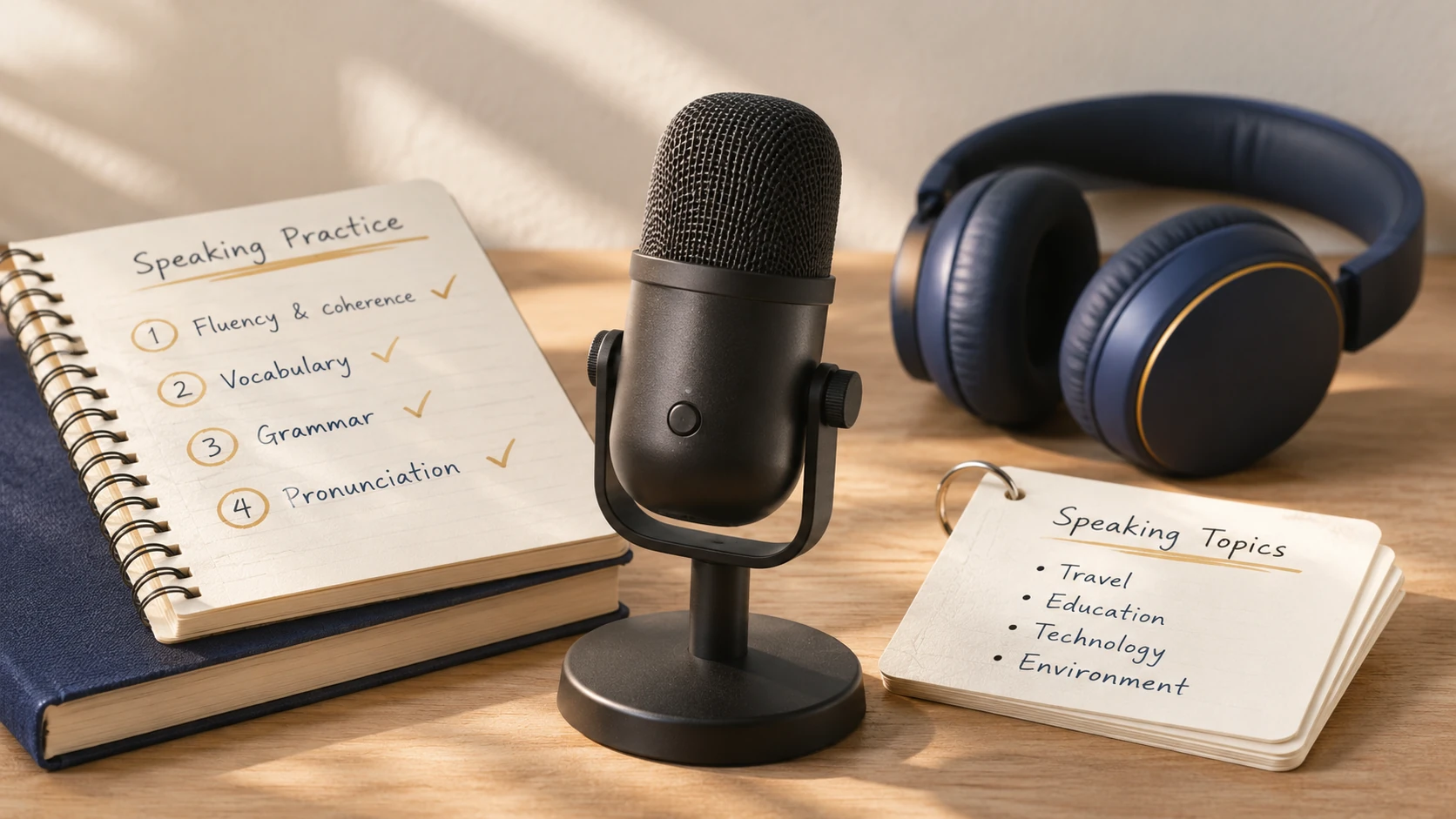
Fluency & Coherence Speaking smoothly without long pauses; ideas are structured logically
-
Lexical Resource Using vocabulary naturally and precisely; paraphrasing effectively
-
Grammatical Range & Accuracy Complex sentences with few mistakes
-
Pronunciation Clear, natural, understandable to any English speaker
Band 8.5 isn’t about perfection. It’s about consistently performing at a near-native level while maintaining clarity, confidence, and natural speech.
The Biggest Challenges to Achieving 8.5
Many students aim high but stumble on a few key issues:
-
Pauses and hesitation, even small breaks reduce fluency scores
-
Limited vocabulary use repeating words or phrases too often
-
Overthinking grammar: trying to be perfect leads to stumbles
-
Weak Part 2 performance: struggling to speak for 1–2 minutes continuously
Does this sound familiar? You’re not alone. Even advanced speakers struggle with fluency under time pressure.
Step 1: Master Fluency and Coherence
Fluency is the backbone of Band 8.5. Here’s how to work on it:
-
Practice thinking aloud
Pick a random topic and speak for 1–2 minutes without stopping. Don’t worry about mistakes; focus on continuous speech. -
Link ideas naturally
Use connectors like “Moreover,” “On the other hand,” and “This shows that…” but don’t overstuff. Examiners prefer smooth flow over flashy words. -
Avoid long pauses
It’s okay to pause briefly to collect thoughts, but avoid saying “um… uh… let me think…” repeatedly.
At United Ceres College, we train students to practice fluency under simulated exam conditions, which dramatically improves confidence and natural speech.
Step 2: Expand Your Vocabulary (Lexical Resource)
Band 8.5 requires more than knowing lots of words. It’s about using them accurately:
-
Use topic-specific vocabulary
For example, when discussing education, words like “curriculum,” “pedagogy,” “assessment,” and “extracurricular” are precise and natural. -
Paraphrase effectively
If the question is “Describe a memorable trip,” you might say “a journey that left a lasting impression on me” instead of repeating “memorable trip.” -
Avoid forced vocabulary
Using complex words incorrectly is worse than using simple words naturally.
Step 3: Perfect Your Grammar
You don’t need to be perfect but you must demonstrate a range of sentence structures:
-
Use complex sentences
Although I enjoy reading, I rarely have time during school days because of extracurricular commitments. -
Mix tenses naturally
Talk about past experiences, current habits, and future plans smoothly. -
Avoid repeating simple sentence structures
Vary sentences to show grammatical range.
United Ceres College emphasises grammar in context, not isolated drills, because examiners notice natural application over memorised rules.
Step 4: Pronunciation & Intonation
Even if your grammar and vocabulary are perfect, unclear pronunciation can drag your band down.
-
Stress key words to highlight important ideas
-
Vary intonation to sound natural, not robotic
-
Practice minimal pairs (ship/sheep, bat/bad) to reduce confusion
Recording yourself and listening back is an underrated strategy. Many students discover small errors they didn’t realise they made.
Step 5: Tackle Part 2 Like a Pro
Part 2 (the long turn) is where most students lose marks.
-
Plan quickly
Use the 1-minute prep to jot down three points and a short conclusion. -
Stick to the topic
Avoid drifting into unrelated stories; examiners notice. -
Use examples
Real-life experiences or personal anecdotes make answers more fluent and convincing.
Tip: Speaking confidently for 1–2 minutes continuously is often harder than Part 3 abstract questions, so practice is essential.
Step 6: Handle Part 3 Effectively
Part 3 tests abstract thinking and discussion:
-
Don’t give short yes/no answers
-
Always justify opinions with examples
-
Use phrases like: “I believe this is because…”, “One possible reason is…”, “From my experience…”
At Band 8.5, examiners expect depth of reasoning, not just correct grammar.
Step 7: Build Exam Confidence
Band 8.5 isn’t just about language; it’s about mindset.
-
Practice with mock tests under time pressure
-
Speak in English daily, even outside exam prep
-
Record and critique yourself, but don’t obsess over mistakes
-
Relax before the exam; anxiety can disrupt fluency and coherence
United Ceres College provides personalised speaking coaching, including mock tests that mimic real exam conditions, helping students perform confidently under pressure.
Step 8: Common Mistakes to Avoid
-
Repeating phrases too often
-
Overcomplicating sentences to impress
-
Forgetting to structure answers clearly
-
Panicking when you forget a word or idea
Mistakes happen. Band 8.5 students recover gracefully, keep speaking, and maintain fluency.
Final Thoughts:
Yes, but it requires a combination of strategy, practice, and self-confidence: Fluent and coherent speech, Precise and varied vocabulary, Range of grammar, Clear pronunciation, Confidence under pressure
You don’t need perfection. You need consistency and practice. At United Ceres College, students who follow structured speaking practice, receive personalised feedback, and simulate exam conditions give themselves the best chance of reaching the higher bands. It’s not impossible; it’s just about knowing what examiners want and practising strategically.
Frequently Asked Questions (FAQ)
1. Is Band 8.5 in IELTS Speaking achievable for non-native speakers?
Yes. Many non-native students achieve Band 8–8.5 with consistent practice, structured preparation, and feedback on fluency and coherence.
2. How much practice is needed to reach 8.5?
Typically, 2–3 months of daily, focused practice under exam conditions is recommended, though timelines vary by student level.
3. Does memorising answers help?
No. Examiners can spot memorised responses. Authentic, relevant, structured answers are what earn Band 8+ scores.
4. Can accent affect band score?
Not significantly. Clear and understandable pronunciation matters more than accent. Intonation, stress, and clarity are key.
5. How can United Ceres College help students achieve Band 8.5?
We provide personalised coaching, mock tests, speaking drills, pronunciation guidance, and strategic feedback, helping students tackle the hardest parts of IELTS Speaking effectively.
Related reading: Top 10 Tips for Mastering IELTS Speaking · Top 10 Tips for Mastering IELTS Writing · Preparatory Course for International English Language Testing System (IELTS)