



IELTS Writing Task 2 Topics with Answers (2026): What Students Actually Need to Prepare
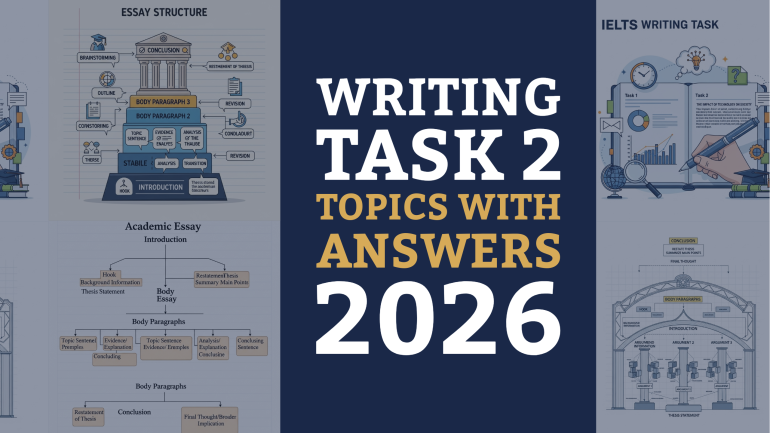
IELTS Writing Task 2 Topics with Answers (2026): What Students Actually Need to Prepare
Table of Contents
You may also interested:


IELTS Writing Task 2 Topics with Answers (2026): What Students Actually Need to Prepare
If you’re searching for IELTS Writing Task 2 topics with answers for 2026, you’re probably not just browsing out of curiosity. You might be sitting with a blank page open, staring at a question like “To what extent do you agree or disagree?” and wondering why your ideas suddenly disappear the moment the timer starts. You’re not alone. At United Ceres College, we see this pattern every year. Students know English. They’ve read model essays.
They understand grammar rules. Yet Writing Task 2 still feels unpredictable, stressful, and sometimes unfair. This guide is not here to overwhelm you with fancy vocabulary or robotic essay templates. Instead, it focuses on realistic IELTS Writing Task 2 topics expected in 2026, clear answer approaches, and what examiners are actually looking for. If you’re preparing at home or alongside professional guidance, this article will help you build clarity and confidence.
What Is IELTS Writing Task 2 (And Why Does It Matter So Much)?
Let’s get one thing straight. IELTS Writing Task 2 carries more weight than Task 1. It contributes twice as much to your Writing band score. In Task 2, you are required to:
- Write at least 250 words
- Respond to an opinion, discussion, problem-solution, or advantage-disadvantage question
- Present clear ideas, support them, and stay relevant
- Do all of this in 40 minutes
Sounds manageable until the pressure kicks in.
Many students lose marks not because their English is weak, but because their ideas are unclear, their structure is shaky, or they misunderstand the question type.
IELTS Writing Task 2 Topics 2026: What Trends Suggest
IELTS does not release official future questions, but patterns are very real.
Based on recent exams, examiner feedback, and teaching experience at United Ceres College, Writing Task 2 topics for 2026 are likely to focus on:
- Education systems and learning methods
- Technology and artificial intelligence
- Work-life balance and remote work
- Environment and climate responsibility
- Health, lifestyle, and mental well-being
- Government responsibility vs individual responsibility
The topics may repeat. The questions will be phrased differently. That’s why memorizing essays doesn’t work and never will.
IELTS Writing Task 2 Topics with Answers (2026): Sample Questions & How to Approach Them
Instead of dumping full memorized essays, this guide focuses on answer strategy, which is exactly what examiners reward.
Topic 1: Education
Question:
Some people believe that online education is more effective than traditional classroom learning and helps students develop better social skills. Discuss both views and give your own opinion.
How to Answer (2026 Approach):
- Paragraph 1: Online education advantages (flexibility, accessibility, technology)
- Paragraph 2: Classroom learning benefits (interaction, teamwork, communication)
- Opinion: A Balanced view of online learning is effective academically, but traditional classrooms better support social development
Key Examiner Focus:
Clear discussion of both sides and a direct opinion. Sitting on the fence loses marks.
Topic 2: Technology & AI
Question:
Artificial intelligence is increasingly used in daily life. Some people think this creates more problems than benefits. To what extent do you agree or disagree?
Answer Strategy:
- Introduce AI clearly (healthcare, education, business)
- Discuss benefits: efficiency, accuracy, time-saving
- Discuss problems: job displacement, privacy concerns
- Opinion: Partial agreement or disagreement with balanced reasoning
At United Ceres College, students often score higher when they acknowledge both sides, even in “agree/disagree” essays.
Topic 3: Work and Lifestyle
Question:
Many people now work from home. Do the advantages of this trend outweigh the disadvantages?
Strong Structure:
- Advantages: flexibility, reduced commuting stress, productivity
- Disadvantages: isolation, blurred work-life boundaries
- Final judgment: advantages outweigh disadvantages if managed properly
Tip: Use conditional language (“if managed well”) to sound natural and mature.
Topic 4: Environment
Question:
Some people believe individuals should be responsible for protecting the environment, while others think governments should take responsibility. Discuss both views and give your opinion.
High-Scoring Approach:
- Individual role: daily habits, awareness, lifestyle choices
- Government role: laws, infrastructure, enforcement
- Opinion: Shared responsibility, but governments play a larger role
This is a classic IELTS topic, expect variations in 2026.
Topic 5: Health & Society
Question:
Modern lifestyles are responsible for increasing health problems. What are the causes, and what solutions can be suggested?
Structure:
- Causes: sedentary habits, processed food, stress
- Solutions: public awareness, individual choices, policy support
Problem-solution essays are common and often mishandled. Keep causes and solutions clearly separated.
Why Students Struggle with Writing Task 2 (Even After Practice)
Here’s what we observe at United Ceres College:
- Writing too descriptively, not analytically
- Memorizing introductions instead of ideas
- Writing off-topic due to misreading the question
- Weak paragraph development
- Poor time management
Writing Task 2 is not about sounding “advanced.” It’s about being clear, relevant, and structured.
How to Prepare for IELTS Writing Task 2 at Home (2026)
Home-based preparation works, but only when it’s guided. A realistic home strategy includes:
- Practicing 2–3 essays per week
- Focusing on one question type at a time
- Reviewing mistakes carefully
- Improving ideas, not just grammar
Many students working independently still seek feedback from United Ceres College to ensure they’re improving in the right direction, not reinforcing bad habits.
Band 7+ Writing Task 2: What Examiners Actually Want
IELTS examiners assess four criteria:
- Task Response: Did you answer the question properly?
- Coherence & Cohesion: Is your essay logically organized?
- Lexical Resource: Is your vocabulary accurate and appropriate?
- Grammatical Range & Accuracy: Are sentences clear and controlled?
Notice what’s missing? They don’t mark creativity. They don’t reward memorized phrases. They reward clarity under pressure.
When Professional Guidance Makes a Difference
Some students improve quickly on their own. Others feel stuck at Band 6 or 6.5. That’s usually when:
- Feedback is missing
- Mistakes are repeated
- Confidence drops
At United Ceres College, Writing Task 2 support often focuses on:
- Essay structure correction
- Idea development
- Examiner-style feedback
- Band score improvement strategies
Many students continue practicing at home while using feedback sessions to recalibrate.
Final Thoughts:
IELTS Writing Task 2 is not about being a “good writer.” It’s about being a clear thinker under time pressure. With the right preparation, Topics stop feeling scary, Ideas flow more naturally, and Scores improve steadily. Whether you’re preparing independently or alongside guidance from United Ceres College, focus on understanding the question, structuring your response, and expressing ideas simply and clearly. That’s what examiners reward every single time.
Frequently Asked Questions (FAQ)
1. Will IELTS Writing Task 2 topics repeat in 2026?
Yes, themes often repeat, though questions are rephrased. Topics like education, technology, environment, and work-life balance are expected to remain common in 2026.
2. Is it safe to memorize Writing Task 2 answers?
No. Memorized essays are easily detected and often score poorly. IELTS rewards original, relevant responses that directly address the question.
3. How many Task 2 essays should I practice weekly?
Most students benefit from writing 2–3 essays per week with proper review. Writing daily without feedback often leads to repeated mistakes.
4. Can I prepare for Writing Task 2 at home?
Yes, home preparation works when it is structured and consistent. However, professional feedback such as that provided by United Ceres College can significantly speed up improvement.
5. What band score is considered good for Writing Task 2?
A Band 7 or above is considered strong and is often required for university admission and professional registration. Achieving this requires clarity, structure, and task awareness.