



How Singapore SMEs Are Adopting AI (Without a Data Science Team)
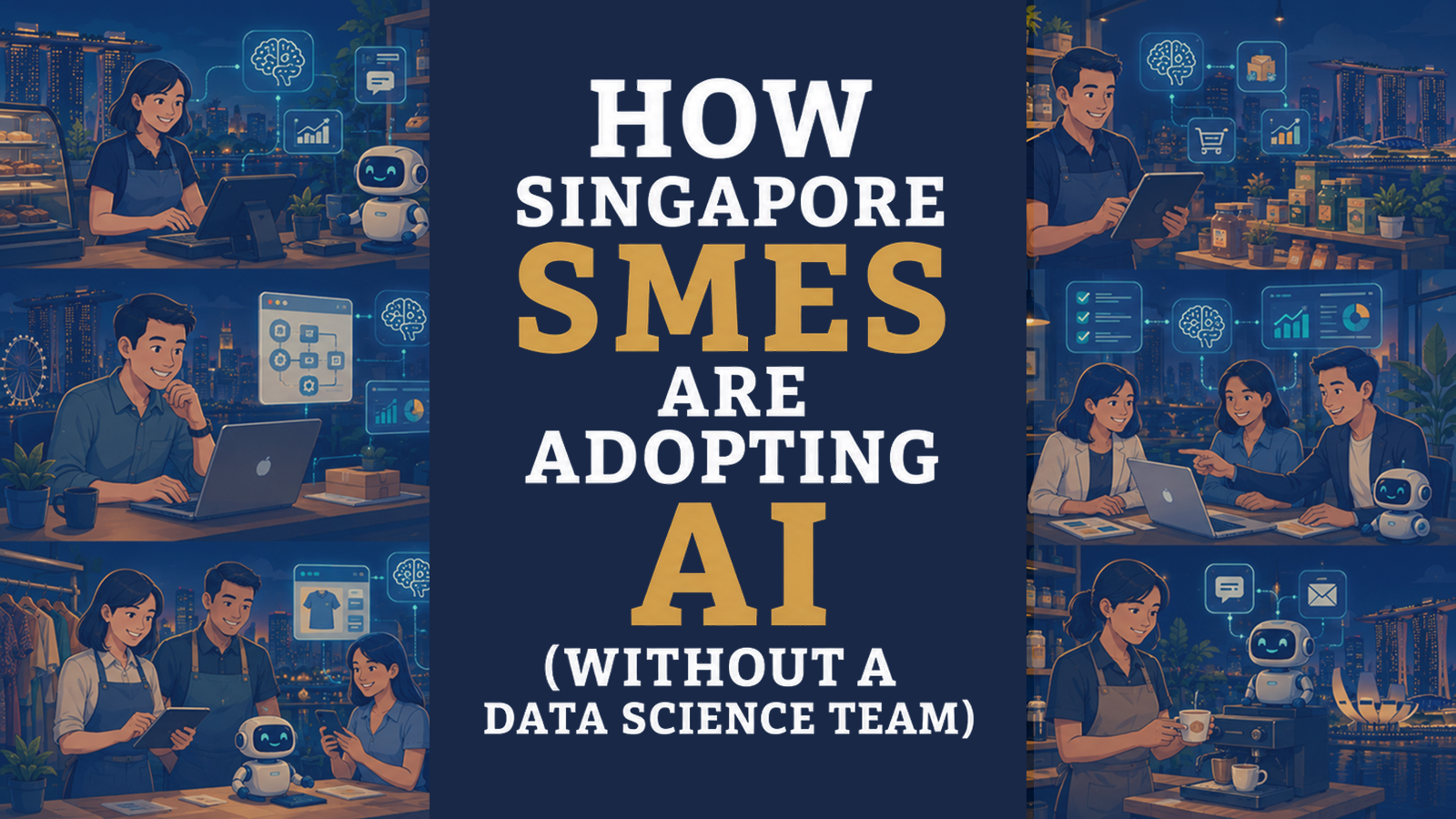
Table of Contents
TL;DR: How Singapore SMEs Are Adopting AI
- Singapore SMEs are increasingly adopting AI to boost productivity, automate routine tasks, and improve decision-making. Many do not have dedicated data science teams, instead relying on user-friendly AI tools that require little or no coding.
- AI is commonly used in customer service, marketing, finance, HR, sales, and operations. Cloud-based platforms and generative AI have made these technologies more accessible and affordable for small businesses.
- Successful AI adoption often begins by solving a specific business challenge rather than transforming the entire organization. As a result, employees with AI knowledge, digital literacy, and problem-solving skills are in growing demand.
- Programs like those offered by United Ceres College introduce AI concepts and real-world applications, helping students build practical skills for an evolving workplace. The success of AI ultimately depends on how it is implemented and the needs of each business.
Artificial intelligence (AI) is often associated with large technology companies that have teams of software engineers, data scientists, and AI specialists. It is easy to assume that only organizations with significant resources can benefit from AI. In reality, that is no longer the case. Across Singapore, many small and medium-sized enterprises (SMEs) are beginning to use AI to improve everyday business operations. What’s interesting is that many of these businesses lack a dedicated data science team. Instead, they are using accessible AI tools to automate routine tasks, improve customer experiences, analyze information, and support decision-making.
This shift is making AI more practical for businesses of all sizes. It also means employees in a wide range of roles from marketing and administration to finance and customer service are increasingly working alongside AI technologies. If you’re considering studying AI or simply want to understand how businesses are using it today, it’s helpful to see how AI is being applied in real-world workplaces.
Why Are Singapore SMEs Investing in AI?
Government initiatives such as the SMEs Go Digital programme, Enterprise Singapore support schemes, and Singapore’s National AI Strategy have encouraged businesses to explore digital technologies, including AI, particularly among SMEs, which make up a significant portion of the country’s economy. Many smaller businesses face similar challenges, including:
- Limited budgets
- Smaller teams
- Increasing customer expectations
- Administrative workloads
- Growing competition
- The need to improve productivity
Hiring an entire AI or data science department is often unrealistic for many SMEs. Fortunately, today’s AI tools are becoming easier to use. Many cloud-based platforms now allow businesses to automate tasks without requiring advanced technical knowledge or large IT departments. Rather than replacing employees, AI is often used to support existing teams by reducing repetitive work and helping staff focus on higher-value activities.
Why AI Is More Accessible Than Ever
A few years ago, implementing AI often required specialist knowledge, expensive software, and significant computing resources. Today, the situation has changed. Many AI-powered tools are available through subscription-based services including generative AI assistants, workflow automation platforms, customer relationship management (CRM) systems with AI features, and productivity software that businesses can start using with minimal setup. Examples include tools for:
- Writing and editing content
- Customer support
- Data analysis
- Appointment scheduling
- Email automation
- Meeting summaries
- Document management
Many of these platforms include built-in AI features that employees can learn to use without becoming programmers, making AI skills for non-technical professionals increasingly valuable.
This accessibility has lowered the barrier for SMEs that want to explore AI without making major investments in technology infrastructure.
What Does AI Adoption Look Like for SMEs?
AI adoption doesn’t always involve complex algorithms or custom-built software. For many SMEs, it begins with solving one practical problem. For example, a company may ask:
- How can we respond to customers faster?
- Can we reduce repetitive administrative work?
- How can we organize information more efficiently?
- Is there a better way to analyze sales data?
Instead of transforming the entire business overnight, many organizations introduce AI gradually. They may start with one department, evaluate the results, and expand AI use over time if it proves helpful. This step-by-step approach allows businesses to learn what works while managing costs and reducing risk.
How Singapore SMEs Are Using AI
AI is now supporting many everyday business functions. Here are some of the most common examples.
Customer Service
Responding to customer inquiries can take considerable time, especially for businesses with small support teams. Many SMEs now use AI-powered chatbots or virtual assistants to answer frequently asked questions. These systems may help customers:
- Check order status
- Find product information
- Book appointments
- Access support resources
- Receive answers outside business hours
More complex inquiries can still be handled by human staff. This combination of AI and human support can improve response times while allowing employees to focus on conversations that require personal attention.
Marketing
Marketing teams often spend hours creating content, planning campaigns, and analysing performance. AI tools can assist with tasks such as:
- Generating content ideas
- Drafting social media posts
- Writing email campaigns
- Summarising marketing reports
- Identifying customer trends
- Suggesting keywords for SEO
Human review remains important to ensure content is accurate, relevant, and aligned with the company’s goals. Rather than replacing creativity, AI can help speed up routine parts of the content creation process.
Administrative Work
Administrative responsibilities are essential, but they can also be time-consuming. SMEs are using AI to help with tasks such as:
- Organising documents
- Scheduling meetings
- Managing calendars
- Summarising meeting notes
- Drafting emails
- Creating reports
Automating repetitive administrative work allows employees to spend more time on communication, planning, and customer engagement.
Finance and Accounting
Finance teams often work with large amounts of information. AI can support routine financial tasks by helping to:
- Categorise expenses
- Organise invoices
- Prepare financial summaries
- Identify unusual transactions
- Generate reports
Financial decisions still require human judgement, but AI can reduce the time spent on manual data processing.
Human Resources
Many HR teams are exploring AI to improve recruitment and employee administration. Examples include:
- Screening job applications
- Scheduling interviews
- Drafting job descriptions
- Answering employee questions
- Organising HR documents
- Supporting onboarding processes
Recruitment decisions continue to involve human review, but AI can assist with repetitive administrative steps.
Real-World Example: A Small Marketing Agency
Imagine a marketing agency with 15 employees. The business does not employ data scientists or AI engineers. Instead, the team uses several AI-powered tools to support daily work. For example:
- AI helps generate content outlines for blogs.
- Meeting software automatically creates summaries.
- Customer inquiries are answered using an AI chatbot outside office hours.
- Marketing reports are generated using AI-powered analytics tools.
- Administrative staff use AI to draft routine emails and organize documents.
No one on the team is building AI models. Instead, they are using existing AI applications to improve efficiency. This is how many SMEs are approaching AI today.
Why SMEs Don’t Always Need a Data Science Team
When people hear the term AI, they often imagine highly technical professionals writing complex code. While those roles remain important, many businesses now use AI without developing the technology themselves.
This is possible because many AI solutions are already built into software that organizations use every day. Employees simply learn how to apply these tools effectively. Instead of hiring specialists to create AI systems from scratch, SMEs often focus on:
- Choosing suitable AI platforms
- Training employees to use them
- Identifying business processes that can benefit from automation
- Monitoring results and making improvements over time
This approach makes AI more accessible to organizations with limited technical resources.
What Skills Are Becoming More Valuable?
As AI becomes more common in workplaces, employers are increasingly looking for people who understand how to work with these technologies. Importantly, this doesn’t always mean becoming a programmer. Many businesses value employees who can:
- Understand AI concepts
- Use AI tools responsibly
- Analyse information
- Solve business problems
- Think critically
- Adapt to new technologies
- Communicate effectively
These skills can support professionals across business, marketing, finance, healthcare, education, and many other industries. Learning how AI fits into everyday work is becoming just as important as understanding the technology itself.
Benefits of AI Adoption for SMEs
AI is becoming a practical business tool rather than something only large technology companies can afford. For many SMEs, the goal is not to replace employees but to help them work more efficiently. Here are some of the ways AI can support smaller businesses.
1. Saves Time on Repetitive Tasks
Many business activities involve routine work, such as entering data, organizing documents, replying to common customer inquiries, or preparing reports.
AI can automate many of these tasks, allowing employees to spend more time on work that requires communication, creativity, or decision-making.
For example, instead of manually creating weekly sales reports, an AI-powered tool may collect the data, organize it into charts, and produce a summary for review.
2. Improves Customer Experience
Customers increasingly expect quick responses when contacting businesses.
AI-powered chatbots and virtual assistants can answer common questions, provide product information, or direct customers to the right department outside normal business hours.
This can improve response times while allowing customer service teams to focus on more complex inquiries.
3. Supports Better Decision-Making
Many AI tools can analyze large amounts of information more quickly than manual methods. For example, a retailer may use AI to identify purchasing trends or predict which products are likely to be in higher demand. Business owners still make the final decisions, but AI can help organize information and highlight useful insights.
4. Helps Businesses Grow Efficiently
As SMEs expand, daily operations often become more complex. AI can support growth by helping businesses manage increasing workloads without immediately adding large administrative teams. Examples include:
- Automating appointment scheduling
- Organising customer information
- Monitoring inventory
- Generating business reports
- Managing internal documentation
This allows businesses to scale some processes more efficiently while maintaining human oversight.
Challenges SMEs May Face When Adopting AI
Although AI offers many opportunities, introducing new technology also comes with challenges. Understanding these can help businesses adopt AI more effectively.
Cost Considerations
Many AI tools operate on monthly or annual subscription plans. While these costs may be lower than hiring specialist teams, businesses should still evaluate whether an AI solution provides value for their needs. Starting with a small project before expanding AI use can help organisations make informed decisions.
Employee Training
AI tools are only effective if employees understand how to use them. Businesses may need to provide training so staff can:
- Use AI tools confidently
- Evaluate AI-generated information
- Recognise inaccurate outputs
- Apply AI responsibly
Developing digital skills remains an important part of successful AI adoption.
Data Privacy and Security
Many AI systems process business and customer information. Organizations should also ensure they comply with Singapore’s Personal Data Protection Act (PDPA) when using AI tools especially for:
- Protecting sensitive information
- Managing customer data
- Following relevant regulations
- Using AI responsibly
Responsible AI practices help build trust with customers and employees.
Understanding AI’s Limitations
AI is a useful tool, but it does not replace human judgement. AI-generated information may contain errors or lack important context. For this reason, businesses should review AI outputs before making decisions that affect customers, finances, or operations.
Common Misconceptions About AI for SMEs
As AI becomes more common, several misconceptions continue to influence how businesses view the technology.
“AI Is Only for Large Companies”
This is no longer true. Many cloud-based AI tools are designed for businesses of all sizes and can often be implemented without large technology teams.
“SMEs Need a Data Science Team”
Not necessarily. Many organizations use AI through existing software platforms that require little or no programming knowledge. Employees learn how to use these tools rather than build AI systems themselves.
“AI Will Replace Every Employee”
AI is generally used to support people rather than replace them. Tasks such as communication, leadership, customer relationships, creativity, and strategic decision-making continue to rely heavily on human skills.
“Using AI Is Too Complicated”
Many modern AI applications are designed with user-friendly interfaces. Employees often learn how to use these tools in much the same way they learn new workplace software.
How SMEs Can Start Using AI
Businesses do not need to transform every process at once, practical AI applications for businesses is practical approach to begin with one challenge that AI could help solve. For example:
Identify a Repetitive Task
Look for activities that employees perform frequently, such as scheduling meetings, organizing documents, or preparing reports.
Choose an Appropriate Tool
Select an AI solution that matches the organization’s needs rather than choosing technology simply because it is popular.
Train Employees
Guide on how the AI tool should be used and explain when human review is necessary.
Monitor Results
Evaluate whether the tool saves time, improves efficiency, or enhances customer experiences. Businesses can then decide whether to expand AI into other areas.
Why AI Skills Matter for Today’s Workforce
As more SMEs adopt AI, employers increasingly value professionals who understand how technology supports business operations. These skills are becoming useful across many industries, including:
- Marketing
- Business administration
- Finance
- Customer service
- Human resources
- Healthcare
- Retail
- Logistics
People who understand both business processes and AI applications may be better prepared to contribute in technology-enabled workplaces.
Importantly, these opportunities are not limited to software developers.
Many organizations need employees who can work effectively alongside AI tools while applying critical thinking and professional judgment.
Learning AI for Real-World Applications
For students considering AI, it is worth looking beyond technical theory alone. Programmes that combine practical learning with real-world applications can help students understand how AI is used across different industries. Useful areas of study may include:
- AI fundamentals
- Digital literacy
- Programming concepts
- Data analysis
- Problem-solving
- Responsible AI practices
- Business applications of AI
At United Ceres College, AI-related programs are designed to develop practical knowledge and industry awareness through guided learning experiences. Depending on the program structure, students may explore AI concepts, programming fundamentals, and real-world applications that support continued learning in an evolving digital economy.
Final Thoughts
Artificial intelligence is no longer reserved for large organizations with dedicated data science teams. Across Singapore, many SMEs are adopting AI by using accessible tools that help automate routine tasks, improve customer service, organize information, and support everyday business decisions. Rather than replacing employees, AI is helping businesses work more efficiently while allowing people to focus on communication, creativity, problem-solving, and strategic thinking. For students and professionals, this shift highlights the growing importance of developing practical artificial intelligence knowledge for future careers. Whether your career interests lie in business, marketing, operations, healthcare, or technology, developing practical AI knowledge can help you understand how digital tools are transforming modern workplaces. Individual career opportunities will continue to depend on your qualifications, experience, skills, and employer requirements, but learning how AI supports business processes can provide a valuable foundation for future growth.
Frequently Asked Questions (FAQs)
1. Can small businesses use AI without hiring a data science team?
Yes. Many SMEs use cloud-based AI tools and software with built-in AI features that require little or no programming knowledge. Employees can often learn to use these tools without developing AI systems themselves.
2. How are Singapore SMEs using AI?
Singapore SMEs are applying AI in areas such as customer service, marketing, finance, human resources, administration, and business operations. Common uses include automating repetitive tasks, analyzing data, creating reports, and improving customer support.
3. What are the benefits of AI for SMEs?
AI can help SMEs save time, improve productivity, support decision-making, automate routine processes, and enhance customer experiences. The benefits depend on how AI is implemented and the specific needs of the business.
4. Do employees need programming skills to use AI tools?
Not always. Many workplace AI tools are designed for non-technical users. While programming is valuable for technical AI careers, many professionals use AI through user-friendly applications that require only basic digital skills and an understanding of AI concepts.
5. Why is learning AI becoming important for business professionals?
As AI becomes more common across industries, employers increasingly value professionals who understand how AI tools can support business operations. Developing practical AI knowledge may help individuals adapt to changing workplace technologies and explore a wider range of career opportunities, depending on their qualifications, experience, and employer requirements.