



AI Diploma Entry Requirements in Singapore: What Students Should Know Before Applying
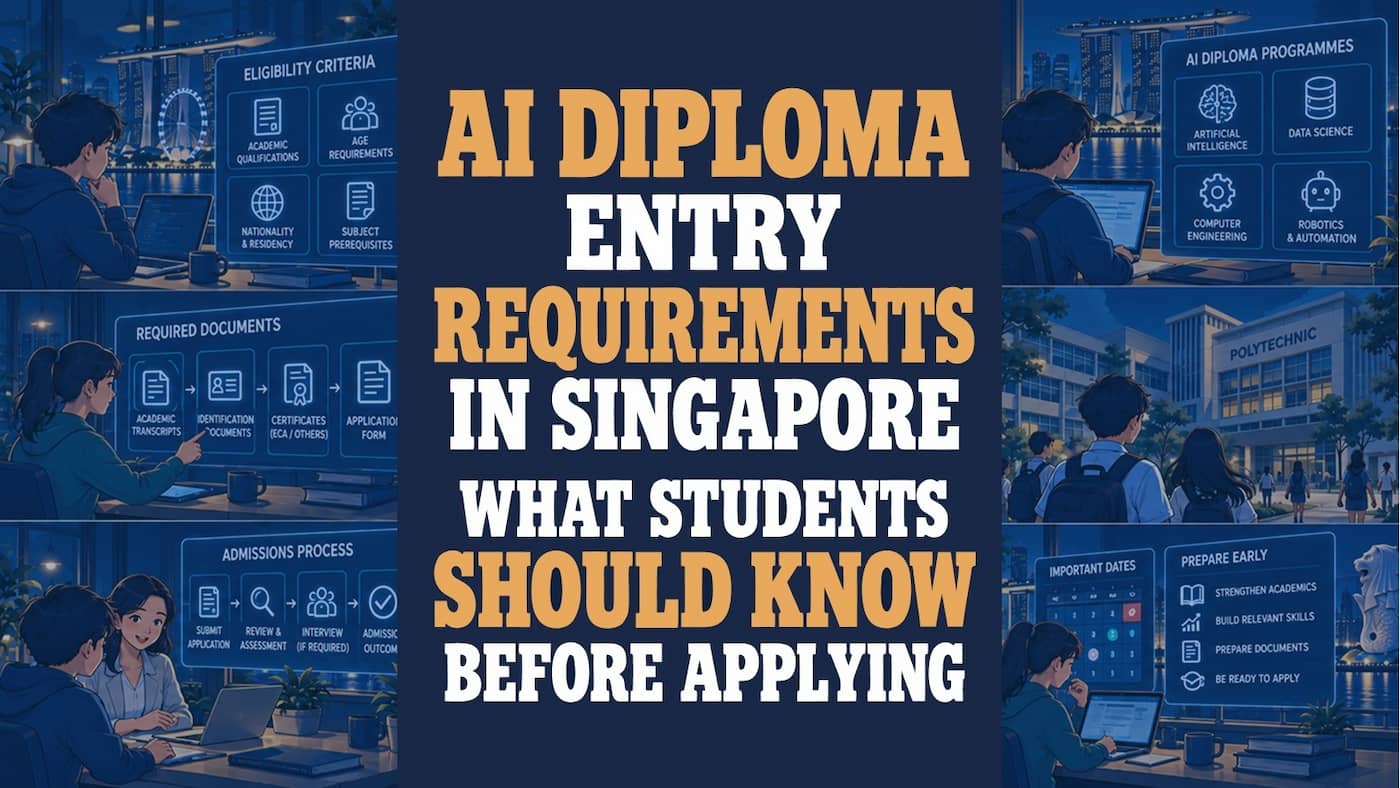
AI Diploma Entry Requirements in Singapore: What Students Should Know Before Applying
Table of Contents


TL;DR: AI Diploma Entry Requirements in Singapore: What Students
- AI diploma entry requirements in Singapore vary by institution and qualification level. Applicants may need to meet academic, English language, and minimum age requirements.
- Entry requirements vary by institution and program, so the exact grades, subjects, and age requirements should always be confirmed directly with the school before applying.
- Understanding entry requirements early can help students avoid delays, prepare the right documents, and apply to programs that genuinely match their academic background.
- At United Ceres College, program requirements are listed clearly for prospective students, so applicants can check what is needed before starting their application.
AI Diploma Entry Requirements in Singapore:
What Students Usually Want to Know First
Many students researching AI diplomas in Singapore want a straightforward answer to one question: do I qualify?
The honest answer is that it depends on the institution, the specific diploma, and the student’s existing qualifications. Singapore has government polytechnics, private education institutions, and international pathway providers, and each sets its own entry criteria. There is no single national requirement that applies to every AI diploma in the country.
That said, most programs look at a similar set of factors: academic qualifications, English language ability, and sometimes age or work experience. Understanding these factors in general terms makes it much easier to figure out which specific program is realistic for your situation.
Why Entry Requirements Differ Between Institutions
Singapore’s diploma landscape includes several types of providers, and this affects how entry requirements are structured.
Government polytechnics (such as Singapore Polytechnic, Ngee Ann Polytechnic, Nanyang Polytechnic, Temasek Polytechnic, and Republic Polytechnic) generally admit students through structured national exercises. Local students usually apply with GCE O-Level or N-Level results, while international students with GCE O-Level qualifications obtained as private candidates typically apply through a separate international admissions exercise.
Private education institutions, including many that offer applied and career-focused AI diplomas, often set their own entry criteria. These can include a minimum number of O-Level passes, completion of a certain number of years of formal education, or equivalent qualifications from the student’s home country.
International students applying from outside Singapore typically need their qualifications assessed for equivalency, along with proof of English proficiency, since instruction is conducted in English.
This is why the same phrase, “AI diploma,” can come with different entry requirements depending on where a student applies.
Typical Entry Requirement Categories
While exact grades vary, most AI diploma programs assess applicants across a similar set of categories.
1. Academic Qualifications
Common accepted qualifications include:
- GCE O-Level certificate (Singapore-Cambridge or equivalent)
- Completion of Secondary 4 or equivalent formal schooling
- Nitec or Higher Nitec qualifications from ITE
- International secondary school certificates (such as IGCSE)
- A relevant polytechnic or foundation diploma, for some advanced entry pathways
Real-life example: A student from Vietnam completes upper-secondary school with results equivalent to O-Levels. Rather than sitting the Singapore-Cambridge exam, the student submits their home-country transcript for equivalency assessment, which many private institutions accept.
2. Minimum Age
Some private diploma programs set a minimum age requirement, commonly around 16 or 17 years old, depending on the institution, alongside academic qualifications. This is separate from the academic criteria and is worth checking, especially for students applying shortly after completing secondary school.
3. English Language Proficiency
Since AI diploma coursework is delivered in English and often involves technical reading, most institutions require evidence of English proficiency. This can typically be shown through:
- A passing grade in English at O-Level
- An IELTS score (commonly around 5.5–6.0, depending on the institution). At UCC, the Diploma requires IELTS 5.5 or equivalent, while the Advanced Diploma requires IELTS 6.0 or equivalent. Both programs also list alternative ways of meeting their English requirements.
- An internal English entrance test conducted by the institution
- Completion of an English preparatory or bridging course
Students who do not meet the English requirement directly are often not rejected outright; many institutions offer a preparatory English program as a pathway into the diploma.
4. Subject-Specific Requirements
Because AI diplomas involve logical reasoning, basic data handling, and sometimes light mathematics, some programs ask for a minimum grade in Mathematics or a related subject at O-Level. This is not universal, and many applied AI diplomas are designed to be accessible to students without a strong mathematics background, teaching foundational concepts from the start.
Comparing Common Entry Pathways
| Pathway | Typical Requirement | Common For |
| GCE O-Level | Minimum number of passing grades, often including English | Students who completed Singapore-based or Cambridge-aligned secondary education |
| International secondary certificate | Equivalency assessment against O-Level standard | International students from non-Singapore school systems |
| Age and education-based entry | Minimum age (e.g. 16) plus completed formal education | Students without formal O-Level certification |
| Foundation or bridging programme | Lower entry threshold, followed by progression into the diploma | Students who narrowly miss direct entry requirements |
This table is a general guide. Some institutions combine criteria, and specific AI diploma programs may add their own conditions.
Common Misconceptions About AI Diploma Entry Requirements
“I need strong mathematics grades to be accepted.”
Some programmes ask for a passing grade in Mathematics, but many applied AI diplomas are built for beginners and teach the required mathematical concepts progressively. A weak grade does not automatically disqualify a student from every programme.
“International qualifications aren’t accepted.”
Most private institutions in Singapore have established processes for assessing international secondary qualifications against local standards. Applicants are usually asked to submit certified transcripts rather than resit local exams.
“If I don’t meet the English requirement, I can’t apply.”
Many institutions offer English preparatory courses specifically for this situation, allowing students to build proficiency before or alongside starting their diploma.
“Entry requirements are the same everywhere.”
As covered above, requirements differ meaningfully between government polytechnics, private institutions, and pathway providers. Comparing programs directly, rather than assuming one standard applies, avoids confusion later in the application process.
“Meeting the minimum requirement guarantees a place.”
Meeting stated entry criteria makes an applicant eligible to apply, but places may still depend on available capacity, application timing, and institution-specific review. Minimum requirements are a starting point, not a guarantee.
Practical Guidance for Applicants
Do I need prior AI or programming knowledge to apply?
Generally, no. AI diplomas at the entry level are usually designed to introduce concepts from the beginning, assuming no prior technical background.
What documents should I prepare in advance?
Most applications require certified academic transcripts, proof of English proficiency (if applicable), a passport copy for international applicants, and sometimes a personal statement. Preparing these early can prevent delays.
What if my qualifications don’t match the listed requirements exactly?
Many institutions review applications individually and may request additional documentation, an entrance test, or an interview rather than rejecting an application outright. It is usually worth contacting the admissions team directly rather than assuming ineligibility.
Do working adults face different requirements?
Some institutions consider relevant work experience alongside or instead of formal academic qualifications for adult learners. This varies significantly between programs, so it is worth asking directly.
How can I find out exact requirements before applying?
The most reliable approach is checking the specific program page of the institution, since requirements are set at the program level and can change between intakes.
Entry Requirements at United Ceres College
At United Ceres College, entry requirements differ between the Diploma and Advanced Diploma in Applied Artificial Intelligence (AI).
For the Diploma in Applied Artificial Intelligence (AI), applicants must be at least 17 years old and meet the published academic requirements, which include passing any three GCE O-Level subjects or equivalent, completing 12 years of formal education, or completing UCC’s Certificate in General Management. English requirements include IELTS 5.5 or equivalent, with alternative options available.
For the Advanced Diploma in Applied Artificial Intelligence (AI), applicants must be at least 17 years old and hold a Diploma from any institution or GCE A-Levels or equivalent. English requirements include IELTS 6.0 or equivalent, with alternative options available.
Both programs also have a mature applicant route for candidates aged at least 30 with eight years of working experience, subject to supporting documentation and admission assessment.
Depending on the program structure, options such as foundation or bridging pathways may also be available for students who do not have a United Ceres College qualification. Also, United Ceres College also lists alternative qualifications and English proficiency options for its Diploma in Applied AI. Applicants should review the published admission criteria or contact the United Ceres College Admissions team to confirm their eligibility. Direct entry requirements apply immediately.
Final Thoughts
Entry requirements for AI diplomas in Singapore are not identical across institutions, and that is normal. Government polytechnics, private institutions, and pathway providers each set their own criteria based on academic qualifications, English proficiency, and sometimes age or work experience.
Rather than assuming eligibility or ineligibility based on one program’s requirements, it is worth comparing a few options directly, checking program pages carefully, and contacting admissions teams with specific questions. This is the most reliable way to find a pathway that genuinely matches your academic background and goals.
Frequently Asked Questions
What is the minimum qualification usually needed for an AI diploma in Singapore?
Most programs look for a GCE O-Level certificate or equivalent, though some private institutions accept alternative qualifications such as Nitec certificates or completed secondary education, depending on the program.
Can international students apply for AI diplomas without Singapore-Cambridge O-Levels?
Yes, in most cases. International secondary qualifications are typically assessed for equivalency, and institutions often outline accepted qualifications by country on their admissions pages.
Is a minimum English test score always required?
Many institutions require proof of English proficiency, such as an IELTS score or a passing English grade, though some offer alternative options like internal English tests or bridging courses.
Do I need programming experience before starting an AI diploma?
Not usually. Entry-level AI diplomas are generally designed for students with no prior technical background and build foundational skills progressively.
Are working adults assessed differently from school leavers?
Some institutions do consider relevant work experience for adult applicants, though this depends on the specific programme and institution, so it’s worth confirming directly.
What should I do if I don’t meet the entry requirements exactly?
Contact the institution’s admissions team. Many offer alternative pathways, additional assessments, or bridging programs for applicants who are close to, but do not fully meet, the stated requirements.