



Data Structures 101: Building Blocks Behind Modern AI Systems
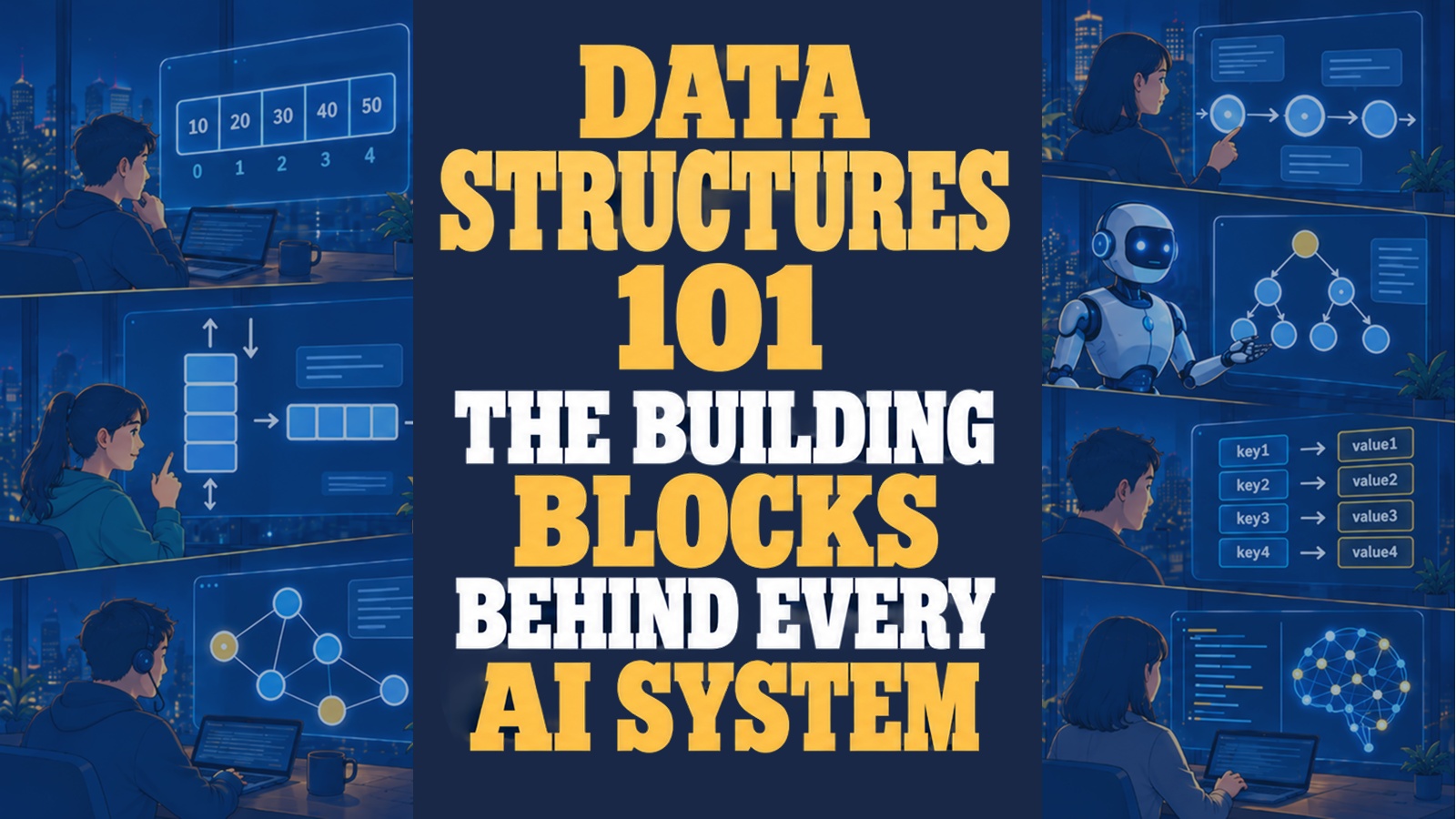
Table of Contents




TL;DR: Data Structures 101: Building Blocks Behind Modern AI Systems
- Data structures are ways of organizing and storing information so that computer programs can access and process it efficiently. They are fundamental to software development and play an important role in AI systems.
- AI models depend on data, and the way that data is represented can affect how efficiently an AI system works. Arrays, lists, trees, graphs, hash tables, and other structures each suit different types of problems.
- Students learning AI do not need to master every advanced data structure immediately. Building a strong foundation in programming, algorithms, and basic data organization can make more advanced AI topics easier to understand.
- United Ceres College‘s Diploma in Applied Artificial Intelligence includes computing foundations relevant to understanding how data and algorithms are used in AI applications.
Artificial intelligence can seem like a field dominated by sophisticated models, enormous datasets, and powerful computers. But underneath all of that technology is something much simpler: data needs to be organized. Before an AI system can analyze customer information, recognize an image, process language, or make a prediction, computers need a way to store and work with the information involved. This is where data structures come in. A data structure is a method of organizing data inside a computer so that it can be accessed, modified, searched, or processed efficiently.
You can think of it like organizing items in your room. If everything is placed randomly on the floor, finding one item can take a long time. If books are placed on a shelf, clothes in a wardrobe, and documents in labeled folders, finding what you need becomes much easier. Computers face a similar problem, except they may need to process millions or billions of pieces of information. For anyone interested in AI, learning data structures provides an important foundation for understanding how software and intelligent systems work.
What Are Data Structures 101?
Data structures are organised ways of storing and managing data in a computer program. Different structures are designed for different purposes. For example:
- An array can store a sequence of values.
- A linked list connects individual elements together.
- A stack follows a last-in, first-out approach.
- A queue follows a first-in, first-out approach.
- A tree represents hierarchical relationships.
- A graph represents connections between objects.
- A hash table can provide fast access using keys.
There is no single data structure that is best for every problem. Choosing an appropriate data structure can improve performance, simplify certain operations and make software easier to manage.
Why Do Data Structures Matter in AI?
AI systems process large amounts of information. Consider a recommendation system. A streaming platform may need to work with information about:
- Users
- Movies
- Shows
- Genres
- Viewing history
- Ratings
- Search behaviour
- Relationships between users and content
This information has to be stored and accessed efficiently. The AI model itself may be sophisticated, but the surrounding software still needs appropriate ways to organise the data. For example, a recommendation system could represent relationships between users and content using structures that make connections easier to analyse. The important point is: AI is not just about models. It is also about how information is represented, stored, accessed, and processed.
Data Structures vs Algorithms
These two terms are often taught together, but they are not the same. A data structure is about how information is organised. An algorithm is a set of steps used to solve a problem or perform a task. A simple way to remember the difference is: Data structure = how data is organised. Algorithm = what you do with the data. Imagine a library. The shelves and filing system represent the data structure. The process for finding a particular book represents the algorithm. The two work together. A well-designed algorithm can still perform poorly if the data is organized inefficiently.
Arrays: A Simple Foundation
An array stores a collection of elements in an ordered structure. For example:
[10, 20, 30, 40, 50]
You can think of an array as a row of numbered boxes. Each value has a position, commonly called an index. Arrays are useful when programs need to work with collections of related values.
Where do arrays appear in AI?
Arrays are particularly important because many AI and machine-learning operations involve numerical data. For example, a dataset could contain:
- Age
- Income
- Purchase frequency
- Customer rating
These values can be represented numerically and processed using array-like structures. In machine learning, data is often represented as vectors, matrices, or higher-dimensional arrays. This makes arrays a fundamental concept for anyone studying AI.
Lists and Dynamic Collections
A list is another common way of storing multiple values. For example, an application might maintain a list of:
- Customer names
- Products
- Search results
- Training examples
Lists can be useful when the number of elements changes during a program. For example, an AI-powered application processing customer enquiries might create a list of unresolved requests. As new requests arrive, they can be added. As requests are completed, they can be removed. The exact implementation depends on the programming language and application.
Stacks: Last In, First Out
A stack follows the principle: Last In, First Out (LIFO). Imagine stacking plates. The last plate placed on the stack is normally the first one removed. Stacks are useful in many computing situations. For example, they can support the following:
- Function calls
- Undo operations
- Expression processing
- Backtracking
- Some search algorithms
A simple example Imagine editing an AI-generated document. You make several changes:
- Add a heading
- Edit a paragraph
- Insert a table
If you press “Undo,” the most recent change is usually reversed first. A stack-like structure can support this type of operation.
Queues: First In, First Out
A queue works differently. It follows: First In, First Out (FIFO), about people waiting in line. The person who arrives first is normally served first. Queues are useful for managing tasks waiting to be processed. For example, an AI system could receive thousands of requests. Instead of attempting to process everything simultaneously, requests may be placed into a queue and handled according to the system’s processing rules. Queues are common in:
- Task processing
- Customer-service systems
- Computer networks
- Message systems
- Background jobs
Trees: Representing Hierarchies
A tree is a structure that represents hierarchical relationships. Think about a family tree. One person may have children, who have their own children. Computer systems can represent similar relationships. A company might have: Company, Departments, Teams, Employees This hierarchy can be represented using a tree-like structure. Trees are also important in areas of computing such as:
- File systems
- Search
- Decision-making
- Databases
- Machine learning
Decision Trees in Machine Learning
One familiar example of a tree-shaped structure in machine learning is the decision tree. A decision tree makes predictions by following a series of questions or conditions. Imagine a system trying to predict whether a customer might purchase a product. It could ask, “Is the customer a returning customer?” If yes, it moves down one branch. If not, it follows another. Then it might ask, “Has the customer viewed the product before?” The process continues until the system reaches a prediction. This is a practical example of how a tree-like structure can be used in machine learning.
Graphs: Representing Connections
A graph represents relationships between objects. It usually contains:
- Nodes, representing objects
- Edges, representing relationships
Imagine a social network. Each person could be represented as a node. A connection between two people could be represented as an edge. The same concept can be applied to many AI problems.
Examples include:
- Social networks
- Road networks
- Recommendation systems
- Knowledge graphs
- Fraud detection
- Search engines
- Supply chains
Graphs become especially useful when the relationships between pieces of information matter.
Graphs and Recommendation Systems
Consider an online shopping platform. A customer buys:
- Running shoes
- Sports socks
- A fitness watch
Other customers who bought running shoes may also have purchased fitness watches. A recommendation system can analyse these relationships. Instead of treating every product as an isolated item, the system can look at connections between: Customers, Products, Purchases Graph-based approaches can help represent such relationships. This does not mean every recommendation system uses a simple graph structure. Modern systems can combine multiple data structures, algorithms, databases, and machine-learning techniques.
Hash Tables: Finding Information Quickly
A hash table stores information using keys. Think of it like a labeled filing cabinet. Instead of searching through every document, you use a label to locate the relevant information. For example: Student ID, student information, or Product ID → Product details Hash tables can provide efficient access to information in many applications. They are widely used in software development and can support tasks such as:
- Searching
- Caching
- Database operations
- Counting
- Storing key-value information
Why Efficiency Matters in AI
Imagine an AI application processing ten records. Almost any reasonable approach may seem fast. Now imagine processing 10 million records. The choice of data structure and algorithm becomes much more important. A small inefficiency repeated millions of times can significantly affect:
- Processing time
- Memory usage
- Computing costs
- System responsiveness
- Scalability
This is why computer science students learn about time complexity and space complexity.
What Is Big O Notation?
You may encounter Big O notation when studying data structures and algorithms. Big O describes how the resource requirements of an algorithm can grow as the input size increases. For example:
- O(1) — constant time
- O(log n) — logarithmic growth
- O(n) — linear growth
- O(n²) — quadratic growth
You do not need to memorize these terms without understanding them. The key idea is simple: An algorithm that works well with 100 items may behave very differently with 100 million items. AI systems often work with large datasets, so scalability matters.
How Data Structures Appear in Machine Learning
Machine-learning systems commonly work with structured numerical representations. Examples include:
Vectors
A vector can represent a collection of numerical features. For example:
[age, income, purchases]
could represent information about a customer.
Matrices
A matrix can represent data arranged in rows and columns. A spreadsheet of customer information is a simple example.
Tensors
Tensors extend the idea of arrays to multiple dimensions. They are commonly used in modern machine-learning frameworks, particularly when processing images, video, audio, and other complex data. These structures allow AI systems to represent information in forms that computational models can process.
Data Structures and Neural Networks
Neural networks are often associated with AI because they power many modern applications. They contain components such as:
- Inputs
- Weights
- Layers
- Activations
- Outputs
The numerical information involved must be stored and manipulated efficiently. Modern machine-learning frameworks use highly optimized numerical structures to perform operations involving large amounts of data. For example, processing an image may involve representing the image as numerical values across several dimensions. A neural network can then perform mathematical operations on those values. This is one reason understanding basic data representation is useful before diving deeply into neural networks.
Data Structures in Natural Language Processing
AI systems that process language also depend on structured representations. A sentence such as:
“AI is changing customer service.”
contains words and relationships between them. NLP systems typically transform text into numerical representations that machine-learning models can process. Depending on the system, information may be organised using:
- Arrays
- Vectors
- Dictionaries
- Trees
- Graphs
- Other specialised structures
The complexity of modern language models is much greater than these basic examples, but the underlying idea remains: information must be represented in a form computers can process.
Data Structures in Computer Vision
Computer vision is another area where data structures matter. An image can be represented as numerical values. A simple grayscale image can be viewed as a grid of pixel values. A colour image contains additional information for different colour channels. AI systems can process these numerical structures to identify patterns. Applications include:
- Image classification
- Object detection
- Facial recognition
- Medical imaging
- Quality inspection
- Autonomous systems
Again, the AI model is only one part of the larger system. The data needs to be represented, stored, processed, and delivered efficiently.
How Data Structures Support AI Applications
Here is a simplified view of how different structures may appear in an AI application.
| Data Structure | Possible AI Application |
| Array | Numerical data and model inputs |
| List | Collections of records or results |
| Stack | Backtracking and task history |
| Queue | Processing incoming requests |
| Tree | Decision systems and hierarchies |
| Graph | Relationships and networks |
| Hash table | Fast key-based lookups |
| Matrix | Structured numerical data |
| Tensor | Images, video, and machine-learning computations |
These are examples rather than fixed rules. A real AI system can use many structures simultaneously.
Common Misconceptions About Data Structures
Misconception 1: Data structures are only for programmers
Programming knowledge is certainly useful for working deeply with data structures. However, understanding the basic concepts can benefit anyone studying AI, data science, software, or technology. It helps explain what happens underneath applications.
Misconception 2: You need to memorise every data structure
No. The goal is to understand what common structures do, their strengths and limitations, and when they may be appropriate.
Misconception 3: Data structures are outdated because AI is more advanced
Modern AI systems still depend on software infrastructure and efficient ways of representing, accessing and processing data.
Misconception 4: Bigger data automatically produces better AI
Not necessarily. Data quality, relevance, representation, and preparation matter. Large amounts of poor-quality data can still produce poor results.
Misconception 5: Data structures are only about speed
Efficiency is important, but data structures also influence how easily information can be managed, updated, searched, and connected.
Do AI Students Need to Learn Data Structures?
For students planning to work seriously with AI or computer science, learning data structures is highly useful. It can help students understand:
- How programs manage information
- How algorithms process data
- Why some approaches are faster than others
- How software systems scale
- How AI applications are built
- Why programming decisions affect performance
Students do not necessarily need advanced knowledge on day one. A sensible learning path is Programming basics, Data structures, Algorithms, Data handling, Machine learning, AI applications The exact sequence can vary by program.
What Should Beginners Learn First?
If you are new to programming, do not start by trying to understand complex AI architectures. Build the foundation first.
Step 1: Learn a programming language
Python is widely used in AI and data-related work, making it a common starting point.
Step 2: Understand variables and data types
Learn how programs represent:
- Numbers
- Text
- Boolean values
- Collections
Step 3: Learn basic data structures
Start with:
- Arrays
- Lists
- Dictionaries
- Sets
Then progress to:
- Stacks
- Queues
- Trees
- Graphs
Step 4: Study algorithms
Learn how to search, sort, traverse, and manipulate data.
Step 5: Connect these ideas to AI
Once the foundation is clear, it becomes easier to understand how AI systems process information.
A Simple Real-Life Example
Imagine an AI-powered university help desk. Students send questions such as:
- “When does registration close?”
- “Where can I find my timetable?”
- “How do I pay my fees?”
- “How can I contact the admissions office?”
A complete system might use several structures. A queue could organise incoming requests. A hash table could quickly find information using a question category or identifier. A tree could organise university information into departments and services. A graph could represent relationships between courses, departments, and requirements. Arrays or tensors could support machine-learning components that classify or understand the questions. The user simply sees a chatbot. Behind that simple conversation can be a surprisingly complex collection of software components.
Where Data-Structure Knowledge Can Be Useful
AI careers are not limited to building machine-learning models. Professionals may work in:
- AI development
- Data science
- Software engineering
- Machine learning
- Data engineering
- AI product development
- Business analytics
- Automation
- Technology consulting
Many of these roles require some understanding of how data is represented and processed. Even professionals who do not write complex algorithms can benefit from understanding the concepts. For example, a product manager working on an AI application may need to communicate with software engineers and data scientists. Understanding basic data structures can make those conversations easier.
Skills That Complement Data Structures
Data structures are only one part of a broader technical foundation. Students can also develop:
Programming
Learn how to write and understand code.
Algorithms
Understand how problems can be solved systematically.
Mathematics
Build familiarity with concepts relevant to data and machine learning.
Statistics
Learn how to interpret data and evaluate results.
Databases
Understand how large amounts of structured information are stored.
Problem-solving
Practice breaking complicated problems into smaller parts.
Communication
Learn how to explain technical ideas clearly.
The Role of Practical Learning
Data structures can seem abstract when students only read definitions. Practical projects make the ideas easier to understand. For example, instead of simply learning what a queue is, students could build a small program that manages customer-service requests. Instead of memorising how a graph works, they could create a simple map showing connections between locations. Instead of learning about dictionaries only from a textbook, they could build a program that stores student information using unique identifiers. These projects help turn concepts into skills.
At United Ceres College, students exploring AI and technology can benefit from learning foundations that connect computing concepts with practical applications. Understanding how data is organized and processed can provide useful preparation for more advanced AI and digital technology topics.
How to Choose an AI Programme as a Beginner
If you are considering an AI-related programme, check whether it covers the fundamentals. Look for subjects or learning outcomes involving:
- Programming
- Data structures
- Algorithms
- Databases
- Data analysis
- Machine learning
- AI fundamentals
- Practical projects
You should also check the entry requirements. Some programs are designed for beginners, while others expect previous programming or mathematics experience. Do not choose a programme simply because it uses the word “AI.” Look at what you will actually learn and how you will practise it.
Final Thoughts
Data structures may not receive as much attention as neural networks or generative AI, but they are part of the foundation that allows software systems to work effectively. AI systems need data. That data needs to be represented. Programs need to process it. Algorithms need to work with it. And the entire system needs to operate efficiently enough to handle real-world workloads. That is why concepts such as arrays, lists, queues, stacks, trees, graphs, hash tables, matrices, and tensors remain relevant to modern AI. For beginners, the most important lesson is not to memorise dozens of definitions.
Instead, learn to ask: What information am I working with? How should it be organised? What operations will I perform? Which structure makes those operations practical? Once you understand that way of thinking, data structures become much more than a programming topic. They become a foundation for understanding how modern software and AI systems handle information. If you are considering studying AI or another technology-related field, building your fundamentals first can make advanced topics easier to approach. A strong understanding of programming, data, algorithms, and problem-solving can support your learning as you move toward machine learning and other AI applications.
Frequently Asked Questions
1. What are data structures in AI?
Data structures are methods of organising and storing information so computer programs can access and process it efficiently. AI systems use many forms of data organisation, including arrays, lists, trees, graphs, matrices, and tensors.
2. Do I need to learn data structures before studying AI?
It is not always a formal requirement, but a basic understanding can be very helpful. Data structures can make programming, algorithms, machine learning, and data processing easier to understand.
3. Which data structures should AI beginners learn?
Beginners can start with arrays, lists, dictionaries, sets, stacks, and queues. As their knowledge develops, they can study trees, graphs, hash tables, matrices, and other structures.
4. Are data structures difficult to learn?
They can seem difficult at first because some concepts are abstract. Practical programming exercises can make them easier to understand. Beginners should learn one structure at a time and practice using it to solve simple problems.
5. How are data structures connected to machine learning?
Machine-learning systems process numerical and other forms of data that need to be stored and manipulated efficiently. Arrays, matrices, and tensors are particularly important for representing information used by many machine-learning systems.
6. Can non-programmers benefit from learning data structures?
Yes. While programming knowledge is important for working directly with data structures, basic understanding can help business, product, analytics, and other professionals communicate more effectively with technical teams and understand how AI applications work.